Also known as: Standard Limb Leads, Frontal Plane Leads, Extremity Leads, Einthoven Leads
Lead Properties
| Lead Type | Overview |
| Placement | Four limb electrodes are used: right arm (RA), left arm (LA), left leg (LL), and right leg (RL — a ground electrode). From these four electrodes, six leads are mathematically derived: I (LA−RA), II (LL−RA), III (LL−LA), aVR (RA reference), aVL (LA reference), aVF (LF reference). Only three electrodes are required to generate all six frontal plane leads. |
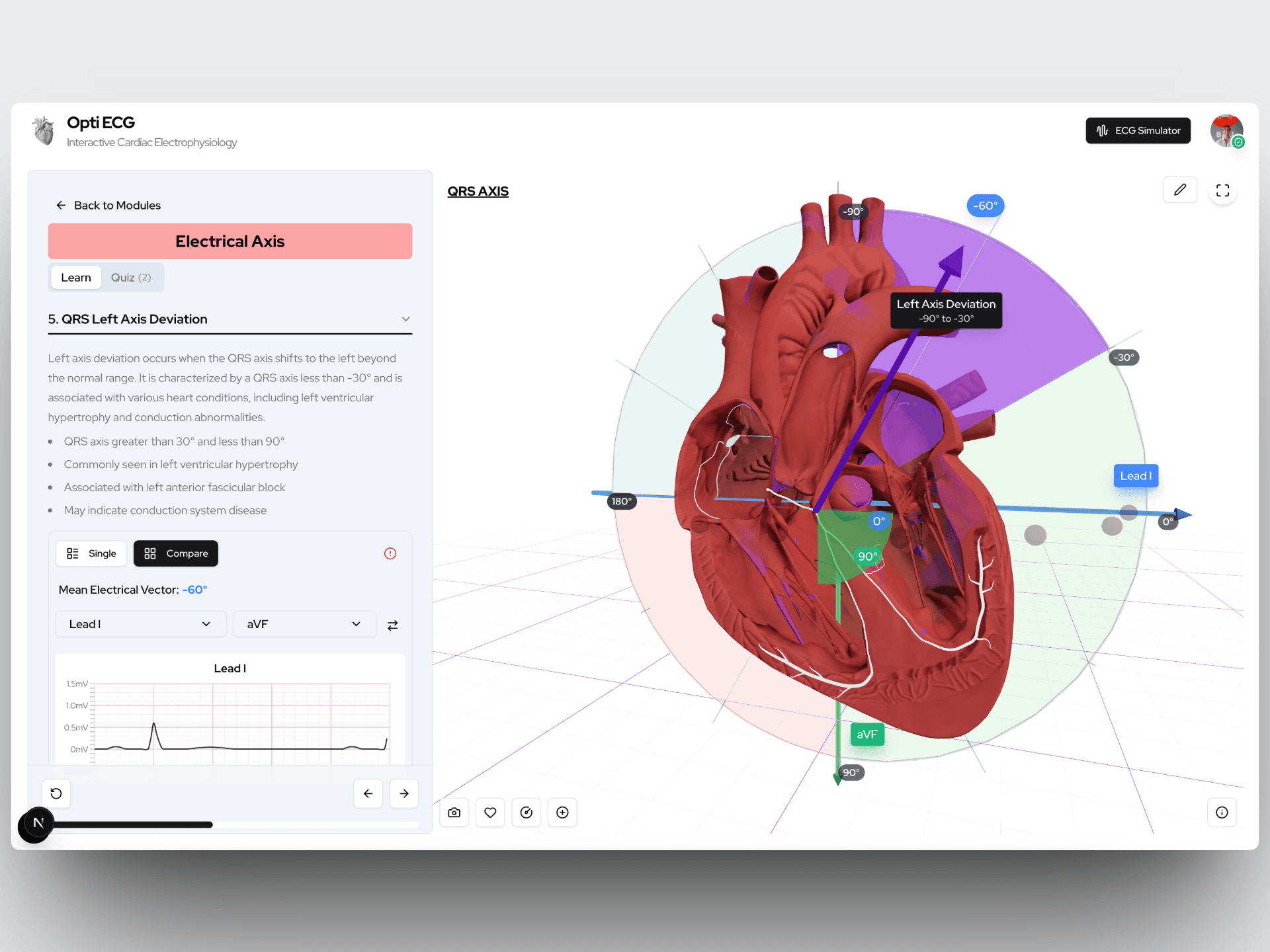
| View of Heart | The frontal (coronal) plane of the heart. The six limb leads collectively provide a 360-degree view of the heart's electrical activity as seen from the front of the body, with each lead oriented at a different angle: Lead I (0°), Lead II (+60°), aVF (+90°), Lead III (+120°), aVL (-30°), aVR (-150°). This coverage allows determination of the frontal plane electrical axis. |
| Clinical Use | Rhythm identification and arrhythmia diagnosis, frontal plane electrical axis determination, inferior MI detection (II, III, aVF), lateral MI detection (I, aVL), P-wave morphology assessment, identification of lead misplacement, bundle branch block diagnosis, and pulmonary embolism pattern recognition. |
Normal Findings
- Upright P waves in I, II, and aVF (atrial depolarization moving leftward and inferiorly)
- Inverted P wave in aVR (always, in sinus rhythm)
- Predominantly positive QRS in I, II, and aVF with normal axis
- Negative QRS in aVR (right arm faces opposite to dominant cardiac vectors)
- Frontal plane axis between 0° and +90° (I positive and aVF positive)
- Consistent PR interval 0.12–0.20 s across all limb leads
- QRS duration < 0.12 s
Abnormal Findings
- Axis deviation: left (negative aVF with positive I) or right (negative I with positive aVF)
- Inferior ST elevation in II, III, aVF indicating inferior STEMI
- High lateral ST elevation in I and aVL indicating lateral STEMI
- Upright P wave in aVR suggesting lead reversal (RA-LA swap)
- S1Q3T3 pattern in Lead I, III suggesting pulmonary embolism
- Prolonged PR interval across limb leads indicating first-degree AV block
- Absent or retrograde P waves suggesting junctional or ectopic rhythm
Frequently Asked Questions
How are all six limb leads derived from just four electrodes?
Einthoven's triangle demonstrates that the three bipolar leads (I, II, III) are mathematically related: Lead II = Lead I + Lead III (Einthoven's law). The augmented leads (aVR, aVL, aVF) are derived by using one limb electrode as the positive terminal and the averaged signal from the other two electrodes as the reference (Wilson's central terminal). Goldberger augmented these derived leads by 50% (by removing the exploring electrode's contribution from the reference) to produce deflections comparable in size to the bipolar leads — hence the 'a' for 'augmented.' The right leg electrode serves only as a ground/reference and does not contribute to any lead recording.
What is the fastest method for determining frontal plane electrical axis from the limb leads?
The fastest clinical method is the four-quadrant technique using Leads I and aVF: if the QRS is positive in both leads, the axis is normal (0° to +90°); positive Lead I with negative aVF indicates left axis deviation (-30° to -90°); negative Lead I with positive aVF indicates right axis deviation (+90° to +180°); negative in both leads indicates extreme right (northwest) axis deviation (+180° to -90°). For more precise axis calculation, the lead in which the QRS is most isoelectric (equal positive and negative deflections) identifies the lead perpendicular to the axis, and the axis is 90° from that lead in the direction of maximal positivity.
How does lead reversal (electrode misplacement) appear in the limb leads?
The most common limb lead reversal is swapping the right arm and left arm electrodes (RA-LA reversal), which causes Lead I to appear inverted (negative P, QRS, and T waves) and leads II and III to swap their morphologies. A key diagnostic clue is an upright P wave in aVR (which should always be negative in sinus rhythm) combined with an inverted P wave in Lead I. Right arm-left leg reversal produces a flat or isoelectric Lead II (since RA and LL effectively become the same point in the circuit). Recognizing lead reversal prevents false diagnoses of arrhythmia, ischemia, or axis deviation.
Why do the inferior leads (II, III, aVF) and lateral leads (I, aVL) show reciprocal changes during MI?
Reciprocal ST changes arise because leads that face each other in the frontal plane see opposite projections of the same ST injury vector. In inferior STEMI, the injury vector points toward the inferior wall (downward in the frontal plane), producing ST elevation in II, III, and aVF. The same vector, projected onto I and aVL — which face in the opposite (superolateral) direction — appears as ST depression. This is not a separate ischemic process but rather a geometric consequence of the frontal plane lead arrangement. Reciprocal changes actually increase the specificity of STEMI diagnosis and can appear earlier than the primary elevation in some cases.
See Limb Leads Overview in 3D
Explore ECG rhythms interactively with our simulator and 3D heart visualization synced beat-for-beat. See how electrical activity produces every wave on the tracing.
Related Topics
How helpful was this page?