Also known as: Lead I, Standard Lead I, Einthoven Lead I
Lead Properties
| Lead Type | Limb |
| Placement | Positive electrode on the left arm (LA); negative electrode on the right arm (RA). In the Einthoven triangle, Lead I forms the horizontal base. |
| View of Heart | Lateral wall of the left ventricle. Lead I faces the left side of the heart, making it sensitive to lateral ischemia, left ventricular hypertrophy, and left axis deviation. |
| Clinical Use | Assessing lateral ST changes, determining electrical axis, diagnosing lateral myocardial infarction, and evaluating left ventricular hypertrophy. Frequently used in axis calculation alongside aVF. |
Normal Findings
- Upright P wave (positive deflection)
- Positive QRS complex with dominant R wave
- Upright or isoelectric T wave
- Small or absent Q wave (< 0.04 s, < 25% of R amplitude)
- ST segment isoelectric within ±1 mm of baseline
- PR interval 0.12–0.20 s
- QRS duration < 0.12 s
Abnormal Findings
- ST elevation suggesting lateral STEMI (LAD diagonal or LCx territory)
- ST depression indicating lateral ischemia or reciprocal change
- Deep Q waves suggesting prior lateral MI
- Broad, notched R waves consistent with left bundle branch block
- Negative QRS deflection indicating right axis deviation
- Inverted T waves in lateral ischemia or LVH strain pattern
- Low voltage QRS (< 5 mm) suggesting pericardial effusion or emphysema
Frequently Asked Questions
What does Lead I measure on the ECG?
Lead I measures the electrical potential difference between the left arm (positive pole) and the right arm (negative pole), producing a view of the heart's electrical activity along a horizontal axis at 0 degrees. Because the positive electrode faces the left side of the chest, it best captures depolarization moving from right to left — the dominant direction in a healthy left ventricle. This makes Lead I particularly useful for assessing lateral wall activity and calculating the frontal plane electrical axis.
How is Lead I used to determine electrical axis?
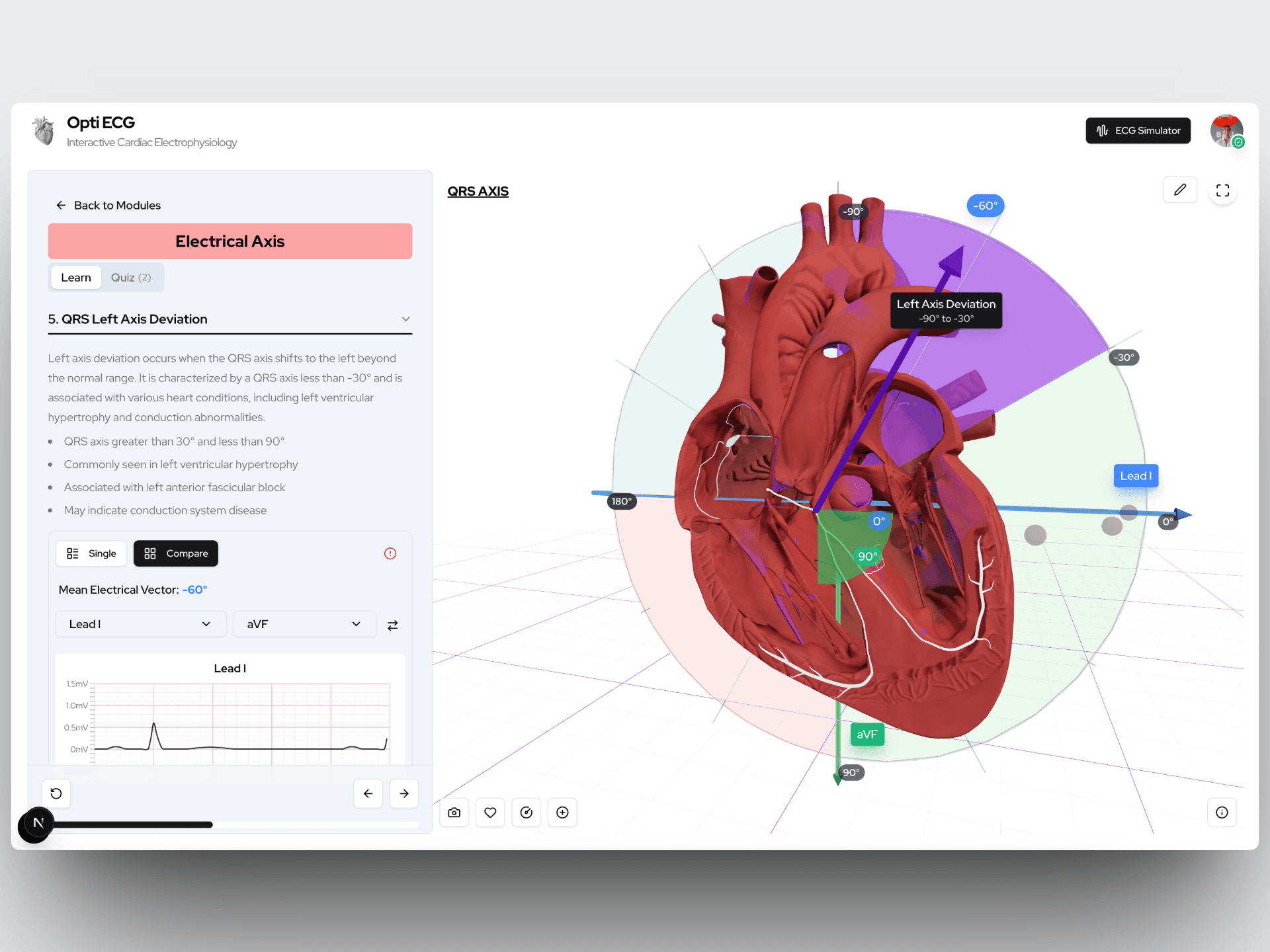
Lead I and aVF together form the cornerstone of a quick four-quadrant axis determination. If Lead I shows a predominantly positive QRS and aVF also shows a predominantly positive QRS, the axis is normal (0 to +90 degrees). A positive Lead I with a negative aVF suggests left axis deviation, while a negative Lead I with a positive aVF indicates right axis deviation. A negative QRS in both leads places the axis in the extreme right (northwest) territory, also called 'no man's land.'
What ST changes in Lead I are clinically significant?
ST elevation in Lead I, particularly when accompanied by changes in aVL and the lateral precordial leads (V5–V6), strongly suggests a lateral wall STEMI — most commonly from occlusion of the left circumflex artery or a diagonal branch of the LAD. ST depression in Lead I can represent either true lateral subendocardial ischemia or a reciprocal change from an inferior MI. Isolated ST depression in Lead I without reciprocal morphology warrants consideration of non-STEMI or demand ischemia.
Why is Lead I negative in right axis deviation?
In right axis deviation, the net electrical force of ventricular depolarization points toward the right side of the chest rather than toward the left. Since Lead I's positive pole is on the left arm, a rightward-directed mean vector points away from that positive electrode, producing a net negative deflection in Lead I. This is the basis of the quick screening rule: a negative Lead I QRS means right axis deviation until proven otherwise.
See Limb Lead I in 3D
Explore ECG rhythms interactively with our simulator and 3D heart visualization synced beat-for-beat. See how electrical activity produces every wave on the tracing.
Related Topics
How helpful was this page?