Also known as: aVF, Augmented Vector Foot, Goldberger Lead aVF
Lead Properties
| Lead Type | Augmented |
| Placement | Positive electrode on the left foot (LF); reference is the combined right arm and left arm electrodes. Oriented exactly downward at +90 degrees, aVF faces directly toward the inferior cardiac surface. |
| View of Heart | Inferior wall of the left ventricle and inferior surface of the right ventricle. At +90 degrees, aVF provides the most direct inferior-facing view of any standard lead, making it essential for detecting inferior ischemia, inferior MI, and diaphragmatic surface pathology. |
| Clinical Use | Diagnosing inferior myocardial infarction in conjunction with Leads II and III, determining electrical axis (normal axis if QRS is positive in both I and aVF), and assessing inferior ST changes, Q waves, and T-wave abnormalities. |
Normal Findings
- Upright P wave (atrial depolarization toward the inferior pole)
- Predominantly positive QRS complex (R wave dominant in normal axis)
- Upright T wave
- Small septal Q waves may be present
- PR interval 0.12–0.20 s
- QRS duration < 0.12 s
- ST segment isoelectric
Abnormal Findings
- ST elevation in inferior STEMI (RCA or LCx occlusion)
- Deep Q waves indicating inferior MI (pathological Q ≥ 0.04 s, ≥ 25% of QRS amplitude)
- ST depression as reciprocal change in high lateral injury
- Negative QRS deflection indicating left axis deviation
- Peaked P waves (P pulmonale > 2.5 mm) suggesting right atrial enlargement
- T-wave inversion in inferior ischemia or right ventricular strain
Frequently Asked Questions
How does aVF contribute to four-quadrant axis determination?
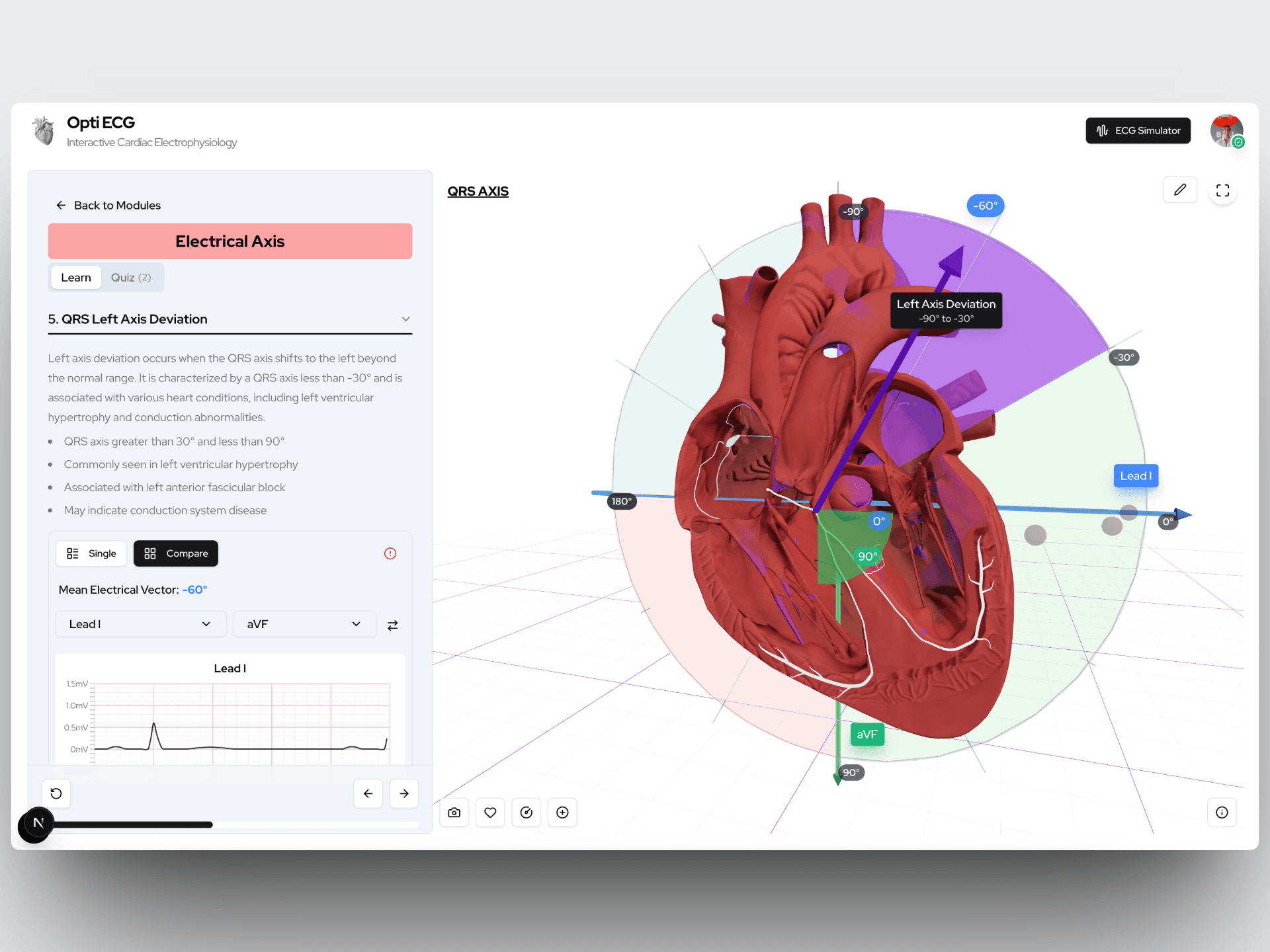
Lead aVF is oriented at exactly +90 degrees — pointing straight down toward the feet — making it the ideal vertical reference for frontal plane axis determination. In the standard four-quadrant method, aVF is paired with Lead I (horizontal reference at 0 degrees). If the QRS is positive in both leads, the axis falls in the normal quadrant (0 to +90 degrees). A positive Lead I with negative aVF indicates left axis deviation, a negative Lead I with positive aVF indicates right axis deviation, and negative in both indicates extreme axis deviation.
What is the significance of ST elevation in aVF?
ST elevation in aVF — particularly when exceeding 1 mm and accompanied by ST elevation in Leads II and III — is a hallmark finding of inferior STEMI. The right coronary artery (RCA) supplies the inferior wall in approximately 85% of people (right-dominant circulation), making RCA occlusion the most common cause. Left circumflex occlusion accounts for most remaining cases. Because the inferior wall also includes the posterior descending artery supply to the SA and AV nodes, inferior STEMI commonly presents with bradycardia and conduction disturbances.
Why are Q waves in aVF not always pathological?
Small, narrow septal Q waves (duration < 0.04 s, amplitude < 25% of the R wave) in aVF represent normal septal depolarization proceeding leftward and superiorly — away from aVF's inferior-pointing positive electrode. These physiological Q waves are common and expected. Pathological Q waves indicating myocardial scar are wider (≥ 0.04 s), deeper (≥ 25% of R wave amplitude), or notched, and they typically appear alongside other abnormalities such as T-wave inversion and loss of R-wave progression. Context, clinical history, and comparison to prior ECGs are essential for correct interpretation.
How does aVF help identify right ventricular infarction?
Right ventricular (RV) infarction almost always accompanies inferior STEMI from proximal RCA occlusion. When inferior ST elevation is present in aVF (with II and III), the clinician should obtain right-sided precordial leads — particularly V4R — to evaluate for RV involvement. ST elevation ≥ 1 mm in V4R in the context of inferior STEMI is highly specific for RV infarction. Recognizing RV infarction is critical because these patients are preload-dependent and nitrates or diuretics (which reduce preload) can cause profound hemodynamic collapse.
See Augmented Lead aVF in 3D
Explore ECG rhythms interactively with our simulator and 3D heart visualization synced beat-for-beat. See how electrical activity produces every wave on the tracing.
Related Topics
How helpful was this page?