Also known as: Lead II, Standard Lead II, Einthoven Lead II, Rhythm Strip Lead
Lead Properties
| Lead Type | Limb |
| Placement | Positive electrode on the left leg (LL); negative electrode on the right arm (RA). In the Einthoven triangle, Lead II forms the right side, spanning from right arm to left leg. |
| View of Heart | Inferior and global cardiac activity. Its axis at +60 degrees closely parallels the normal mean electrical axis of the heart, providing tall, clear P waves and QRS complexes ideal for rhythm assessment. Also views the inferior wall of the left ventricle. |
| Clinical Use | Primary rhythm monitoring lead in clinical settings. Used for detecting arrhythmias, identifying P wave morphology, measuring PR and QRS intervals, and diagnosing inferior myocardial infarction. The standard lead for continuous bedside and telemetry monitoring. |
Normal Findings
- Upright, monophasic P wave (tallest and most consistent of the limb leads)
- Dominant upright QRS complex with tall R wave
- Upright T wave
- PR interval 0.12–0.20 s
- QRS duration < 0.12 s
- Small septal Q wave may be present
- QTc within normal limits (< 440 ms men, < 460 ms women)
Abnormal Findings
- ST elevation indicating inferior STEMI (RCA or LCx occlusion)
- ST depression representing reciprocal change or subendocardial ischemia
- Absent, biphasic, or retrograde P waves suggesting ectopic atrial or junctional rhythm
- Multiple P waves per QRS indicating atrial flutter or fibrillation
- Widened QRS suggesting bundle branch block or ventricular rhythm
- Peaked P waves (P pulmonale) > 2.5 mm indicating right atrial enlargement
- Prolonged PR interval (> 0.20 s) indicating first-degree AV block
Frequently Asked Questions
Why is Lead II the standard rhythm monitoring lead?
Lead II is oriented at +60 degrees in the frontal plane, which closely aligns with the normal mean electrical axis of the heart (typically 0 to +90 degrees). This alignment produces tall, well-defined upright P waves and QRS complexes — ideal for identifying rhythm disturbances, counting rate, and assessing P-wave morphology. The tall P waves in Lead II make it far easier to detect atrial activity compared to other leads, which is essential for rhythm analysis.
How does Lead II help diagnose inferior myocardial infarction?
Lead II faces the inferior wall of the left ventricle alongside leads III and aVF. In an inferior STEMI — typically caused by right coronary artery (RCA) or left circumflex (LCx) occlusion — ST elevation develops in all three inferior leads, with Lead II often showing prominent changes. The combination of ST elevation in II, III, and aVF with reciprocal ST depression in the high lateral leads (I and aVL) is the classic pattern for inferior STEMI.
What does a negative P wave in Lead II indicate?
A negative (inverted) P wave in Lead II indicates that atrial depolarization is traveling in a retrograde direction — from the AV node upward toward the atria — rather than the normal top-down direction from the SA node. This finding is characteristic of junctional rhythms, where the impulse originates in or near the AV node and activates the atria retrogradely. It can also be seen with ectopic atrial rhythms originating in the low atrium or coronary sinus.
Can Lead II alone diagnose an arrhythmia?
Lead II is the best single lead for rhythm analysis and can often identify arrhythmias based on P-wave presence, morphology, PR relationship, QRS width, and regularity. However, a 12-lead ECG is required for definitive arrhythmia diagnosis in most cases, as some rhythms (such as ventricular tachycardia versus SVT with aberrancy) require multiple leads and specific criteria (Brugada algorithm, Vereckei criteria) for accurate classification.
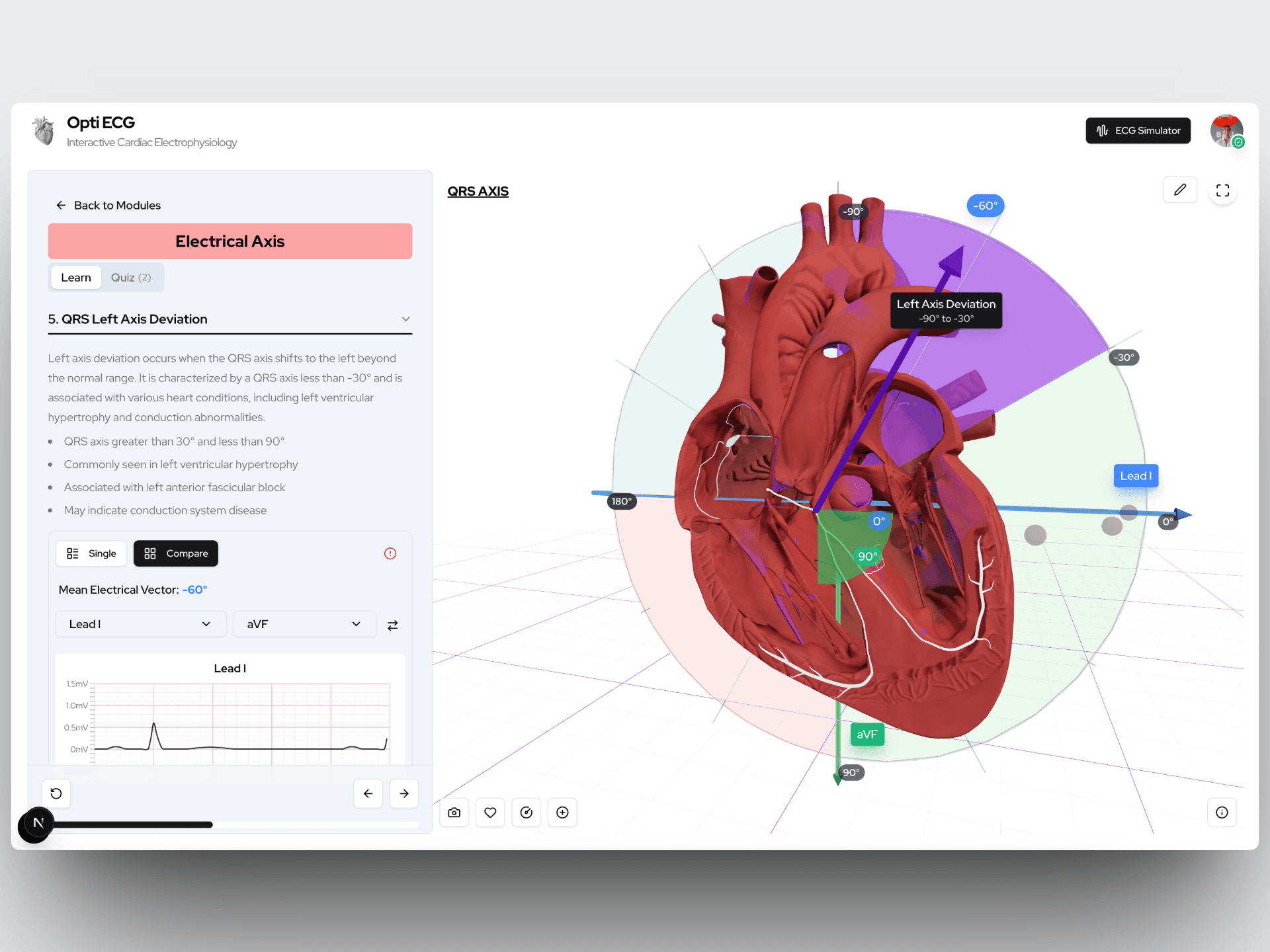
See Limb Lead II in 3D
Explore ECG rhythms interactively with our simulator and 3D heart visualization synced beat-for-beat. See how electrical activity produces every wave on the tracing.
Related Topics
How helpful was this page?