Also known as: Lead III, Standard Lead III, Einthoven Lead III
Lead Properties
| Lead Type | Limb |
| Placement | Positive electrode on the left leg (LL); negative electrode on the left arm (LA). In the Einthoven triangle, Lead III forms the left side, spanning from left arm to left leg. |
| View of Heart | Inferior wall of the left ventricle from a rightward perspective. At +120 degrees, Lead III captures inferior wall activity and is particularly sensitive to changes in the right-inferior direction, complementing Leads II and aVF in the inferior group. |
| Clinical Use | Diagnosing inferior myocardial infarction, determining electrical axis, and detecting right heart strain patterns. Lead III is interpreted alongside II and aVF when evaluating inferior ischemia and alongside I and aVL for axis determination. |
Normal Findings
- Variable P wave morphology (may be upright, biphasic, or isoelectric depending on axis)
- Predominantly positive QRS, though small Q waves and variable morphology are common
- T wave morphology variable — may be upright, flat, or slightly inverted in normal individuals
- Physiologically, Lead III findings should be interpreted in context of the other limb leads
- QRS duration < 0.12 s
- PR interval 0.12–0.20 s
Abnormal Findings
- ST elevation in inferior STEMI (in conjunction with II and aVF)
- Deep Q waves indicating prior inferior MI or right ventricular strain
- S1Q3T3 pattern (prominent S in Lead I, Q wave and inverted T in Lead III) suggesting acute pulmonary embolism
- Right bundle branch block morphology contributing to wide S wave in Lead I
- ST depression as reciprocal change to high lateral injury
- Isolated T-wave inversion in Lead III may indicate right ventricular strain or inferior ischemia
Frequently Asked Questions
What is the S1Q3T3 pattern and what does it indicate?
The S1Q3T3 pattern refers to a prominent S wave in Lead I, a Q wave in Lead III, and an inverted T wave in Lead III. This combination classically suggests acute right heart strain, most notably from pulmonary embolism causing acute pressure overload of the right ventricle. However, S1Q3T3 has limited sensitivity (occurring in fewer than 20% of PE cases) and low specificity — it can be seen in other conditions such as right ventricular hypertrophy and normal variants — so it should never be used in isolation to diagnose or exclude PE.
Why do T waves sometimes appear inverted in Lead III in normal individuals?
Lead III is oriented at +120 degrees, which is angled significantly away from the dominant left ventricular vectors. In individuals with a more horizontal or leftward heart position, the T-wave vector may project as a small negative deflection in Lead III without indicating pathology. Isolated T-wave inversion limited to Lead III — without corresponding changes in Leads II and aVF — is generally considered a normal variant, particularly when all other leads are normal and the patient is asymptomatic.
How is Lead III used to confirm inferior myocardial infarction?
In inferior STEMI, ST elevation typically develops simultaneously in Leads II, III, and aVF. Lead III can help localize the culprit artery: when ST elevation is greater in Lead III than in Lead II, the right coronary artery (RCA) is more likely the culprit, whereas ST elevation greater in Lead II than Lead III suggests left circumflex artery occlusion. This distinction has clinical relevance because RCA occlusion is more commonly associated with right ventricular infarction, which has important hemodynamic management implications.
Can Lead III findings be misleading without considering other leads?
Yes — Lead III is among the most variable and positionally dependent of the standard leads, making isolated interpretation potentially misleading. Changes in body position, respiration, and cardiac rotation all affect Lead III morphology. Q waves, T-wave inversions, and even mild ST changes that appear pathological in isolation may be entirely normal when viewed alongside Leads I, II, and aVF. For this reason, the inferior leads are always interpreted as a group, and no isolated finding in Lead III should prompt clinical action without corroboration.
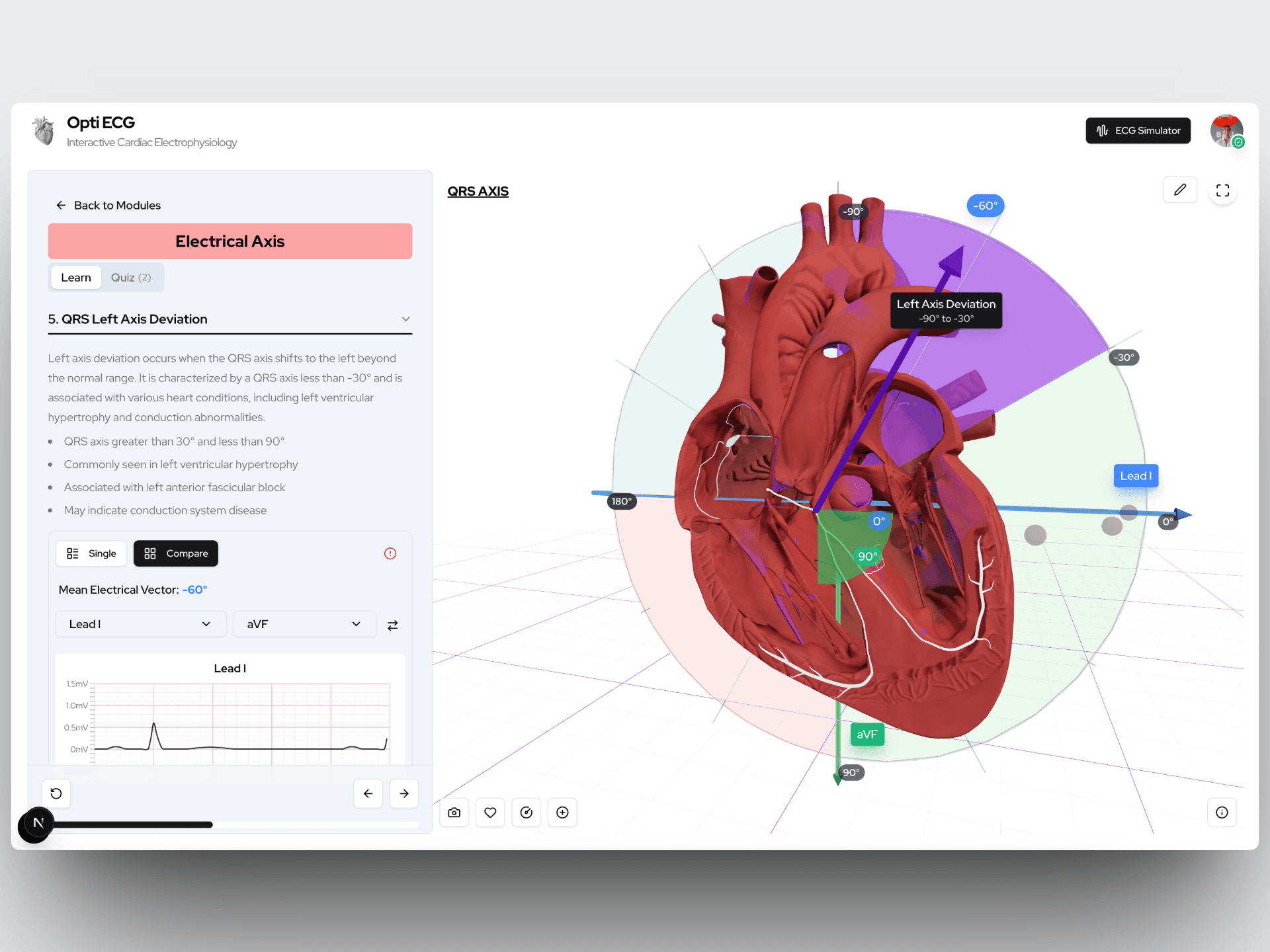
See Limb Lead III in 3D
Explore ECG rhythms interactively with our simulator and 3D heart visualization synced beat-for-beat. See how electrical activity produces every wave on the tracing.
Related Topics
How helpful was this page?