Also known as: aVL, Augmented Vector Left, Goldberger Lead aVL
Lead Properties
| Lead Type | Augmented |
| Placement | Positive electrode on the left arm (LA); reference is the combined right arm and left leg electrodes. As with all augmented leads, the signal amplitude is increased by 50% to make it comparable to the bipolar limb leads. |
| View of Heart | High lateral wall of the left ventricle. At -30 degrees, aVL looks at the heart from the left shoulder, capturing activity in the territory of the first diagonal branch of the LAD and the high marginal branches of the left circumflex artery. |
| Clinical Use | Diagnosing high lateral myocardial infarction, assessing left axis deviation, evaluating left ventricular hypertrophy, and detecting bundle branch blocks. aVL frequently shows reciprocal changes during inferior STEMI (ST depression in aVL with inferior ST elevation). |
Normal Findings
- Variable P wave — may be upright, biphasic, or flat depending on cardiac axis
- Variable QRS morphology — can be predominantly positive or negative depending on axis
- T wave may be upright or flat; isolated T-wave inversion in aVL can be normal
- Small Q waves may be present (lateral septal depolarization)
- QRS duration < 0.12 s
- PR interval 0.12–0.20 s
Abnormal Findings
- ST elevation in high lateral STEMI (diagonal branch or high LCx occlusion)
- ST depression as reciprocal change to inferior STEMI (most sensitive reciprocal lead for inferior injury)
- Deep Q waves indicating prior high lateral infarction
- Tall, broad R wave with ST depression and T-wave inversion in left ventricular hypertrophy strain pattern
- S wave broadening in right bundle branch block
- Left bundle branch block producing broad, notched R wave in lateral leads
Frequently Asked Questions
Why is aVL considered the most sensitive reciprocal lead for inferior STEMI?
Lead aVL is oriented at -30 degrees — nearly directly opposite the inferior leads (which are oriented between +60 and +120 degrees in the frontal plane). When the inferior wall depolarizes abnormally outward due to STEMI, the injury vector points inferiorly, generating reciprocal ST depression in aVL because its positive pole faces the opposite direction. Studies show that ST depression in aVL can actually appear before ST elevation becomes apparent in the inferior leads, making aVL monitoring valuable for early inferior STEMI detection.
What does isolated ST elevation in aVL indicate?
Isolated ST elevation in aVL, especially when accompanied by reciprocal ST depression in the inferior leads (II, III, aVF), suggests a high lateral STEMI due to occlusion of the first diagonal branch of the left anterior descending artery or a high marginal branch of the left circumflex artery. Because the territory is small, isolated high lateral STEMI may produce only subtle or absent changes in the precordial leads, making careful inspection of aVL (and Lead I) critical for diagnosis.
How is aVL used in the diagnosis of left ventricular hypertrophy?
Left ventricular hypertrophy (LVH) criteria in aVL include the Sokolow-Lyon criterion (S in V1 + R in V5 or V6 ≥ 35 mm) and the aVL voltage criterion (R wave in aVL ≥ 11–13 mm depending on the criteria set used). The Cornell voltage criterion combines R in aVL + S in V3: values greater than 28 mm in men or 20 mm in women suggest LVH. LVH strain pattern — ST depression with asymmetric T-wave inversion in aVL — indicates pressure overload changes and increases the risk for adverse cardiovascular outcomes.
When is T-wave inversion in aVL considered normal versus pathological?
Isolated T-wave inversion in aVL with an upright QRS complex and no accompanying ST changes or symptoms can be a normal variant, particularly in individuals with a vertical cardiac axis where the T-wave vector is directed inferiorly away from aVL's positive pole. T-wave inversion in aVL becomes pathological when it is accompanied by Q waves (suggesting prior infarction), evolves over time, occurs with chest pain, or is associated with LVH strain pattern in the setting of hypertension or aortic stenosis.
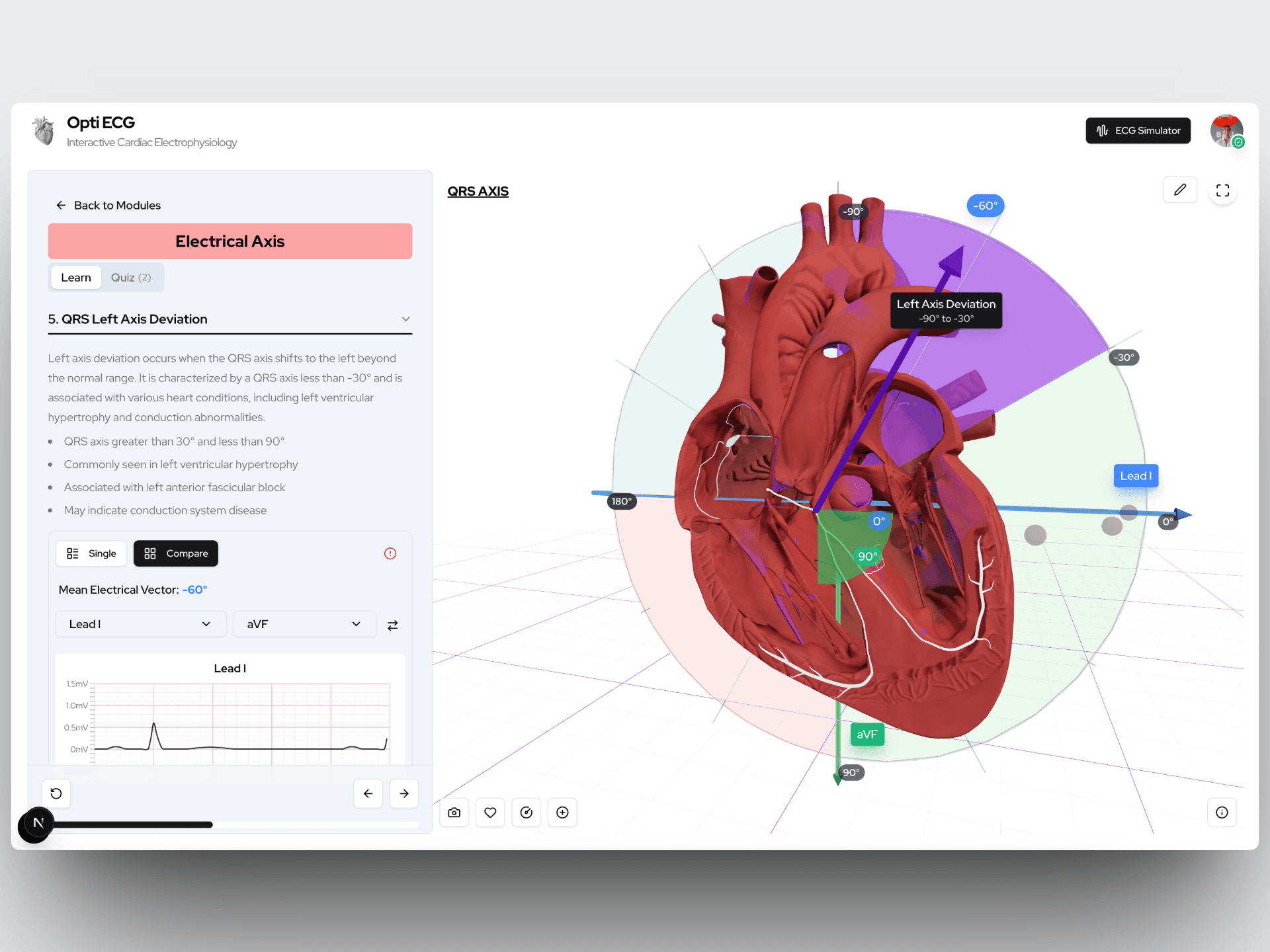
See Augmented Lead aVL in 3D
Explore ECG rhythms interactively with our simulator and 3D heart visualization synced beat-for-beat. See how electrical activity produces every wave on the tracing.
Related Topics
How helpful was this page?