Also known as: V6, Chest Lead 6, Precordial Lead 6
Lead Properties
| Lead Type | Precordial |
| Placement | Positive electrode at the midaxillary line, at the same horizontal level as V4 and V5. The midaxillary line runs vertically through the midpoint of the axilla (armpit). V6 is the most posterior of the standard chest leads. |
| View of Heart | Lateral and posterolateral left ventricular wall. V6 faces the left lateral free wall from a slightly posterior angle, making it complementary to V5 for detecting lateral pathology and closely related to the lateral limb leads (I, aVL) in the territory it represents. |
| Clinical Use | Diagnosing lateral MI (alongside V5, I, and aVL), contributing to Sokolow-Lyon LVH criteria, evaluating left bundle branch block (V6 shows the terminal R wave pattern), assessing lateral ischemia, and confirming the precordial R-wave progression endpoint. |
Normal Findings
- Tall, dominant R wave (slightly shorter than V5 in most individuals as distance from apex increases)
- Small or absent Q wave (normal lateral septal depolarization)
- Upright T wave
- Narrow QRS (< 0.12 s)
- Isoelectric ST segment
- R-wave amplitude typically equal to or slightly less than V5
Abnormal Findings
- ST elevation in lateral STEMI (LCx or high diagonal branch occlusion)
- Deep Q waves indicating prior lateral MI
- ST depression and T-wave inversion in lateral ischemia or LVH strain
- Broad, slurred R wave in left bundle branch block
- Broad terminal S wave in right bundle branch block
- R wave amplitude decrease from V5 to V6 (unusual and may indicate lateral pathology)
- Low-voltage QRS (< 5 mm) in all precordial leads suggesting effusion or subcutaneous emphysema
Frequently Asked Questions
How does V6 relate to the lateral limb leads in identifying lateral MI?
V6, along with V5, I, and aVL, constitutes the lateral lead group. These four leads collectively survey the lateral wall of the left ventricle — territory supplied by the left circumflex artery and its marginal branches, as well as the diagonal branches of the LAD. In a lateral STEMI, ST elevation should appear in at least two of these contiguous leads. V6 and V5 often show the most prominent ST changes in lateral STEMI, while I and aVL may show more subtle changes depending on the exact territory involved.
What does the R-wave pattern in V6 look like in left bundle branch block?
In left bundle branch block, V6 shows a broad, tall, monophasic R wave without a preceding Q wave, often with a notch or plateau at the peak. This reflects the delayed, cell-to-cell propagation of activation across the left ventricle rather than the normal rapid Purkinje delivery. The QRS duration is ≥ 0.12 s, and secondary ST depression and T-wave inversion in V6 are expected (concordant changes are defined by the ST segment moving opposite to the QRS; discordant changes in the same direction as the QRS raise concern for superimposed ischemia — the Smith-modified Sgarbossa criteria).
Why does R-wave amplitude sometimes decrease from V5 to V6?
A slight decrease in R-wave amplitude from V5 to V6 is common because V6 is more laterally and posteriorly positioned, moving farther from the cardiac apex and closer to the lateral chest wall. The net left ventricular vector projects most strongly toward V5's position. However, a pronounced drop in R amplitude from V5 to V6, or an unexpectedly small R wave in V6, should prompt consideration of lateral MI, electrode misplacement, or significant left ventricular dysfunction in the lateral territory. Serial comparison and clinical context are important for interpretation.
Is the Sokolow-Lyon criterion met using V5 or V6 for LVH diagnosis?
The Sokolow-Lyon criterion uses the taller R wave of either V5 or V6 added to the S wave in V1: if the sum is ≥ 35 mm, voltage criteria for LVH are met. Clinicians compare R wave amplitude in both V5 and V6 and use whichever is larger in the calculation. In some individuals the R wave is taller in V5, while in others V6 produces the taller measurement depending on cardiac rotation and electrode position. Both leads should always be measured when calculating LVH voltage criteria to ensure the criterion is correctly applied.
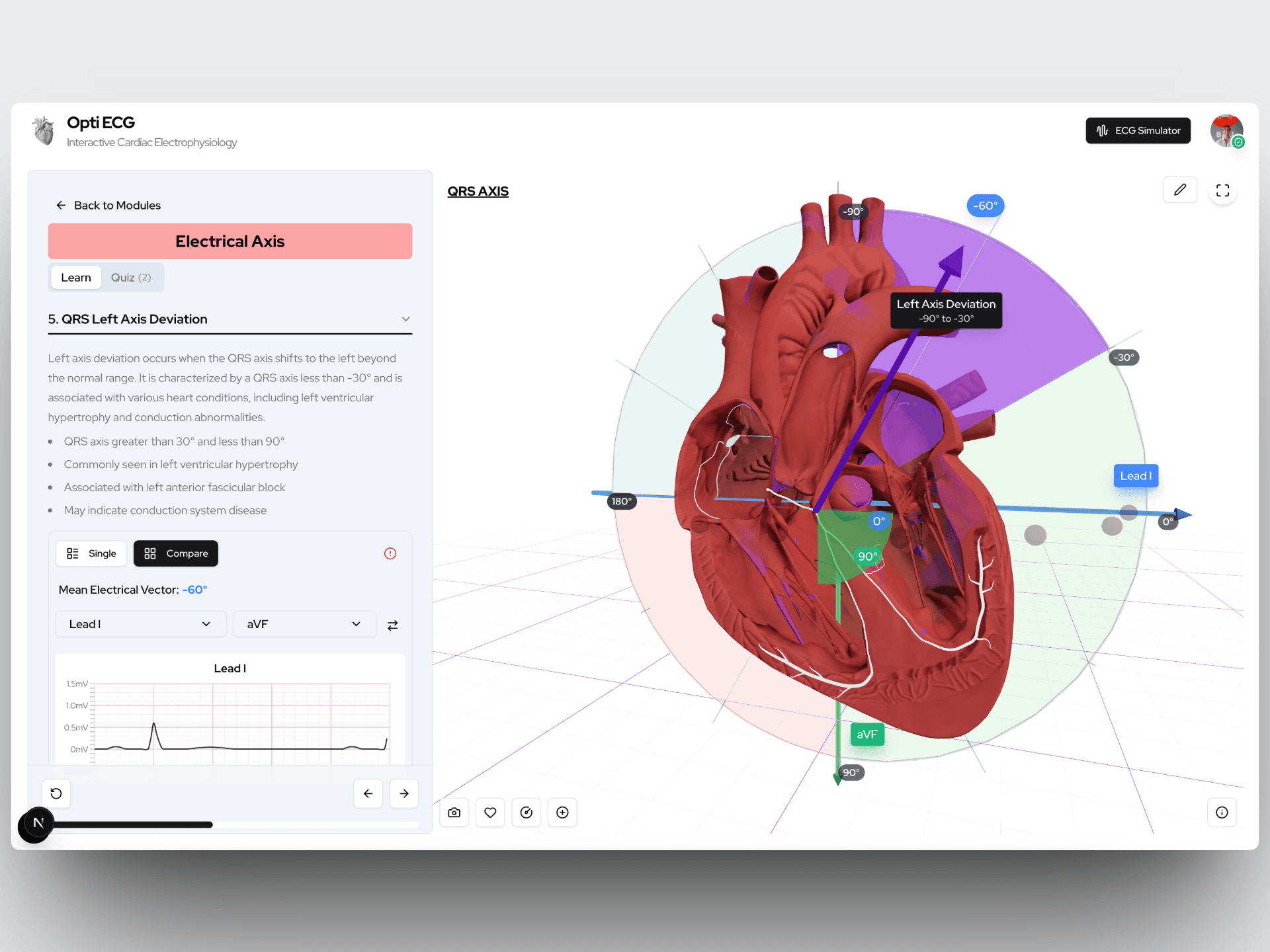
See Precordial Lead V6 in 3D
Explore ECG rhythms interactively with our simulator and 3D heart visualization synced beat-for-beat. See how electrical activity produces every wave on the tracing.
Related Topics
How helpful was this page?