Also known as: V5, Chest Lead 5, Precordial Lead 5
Lead Properties
| Lead Type | Precordial |
| Placement | Positive electrode at the anterior axillary line, at the same horizontal level as V4 (fifth intercostal space or the V4 level if the fifth space is not used). The anterior axillary line is the vertical line at the anterior fold of the axilla. |
| View of Heart | Lateral wall of the left ventricle. V5 faces the large muscle mass of the left ventricular free wall, making it a high-voltage lead that is critical for detecting lateral ischemia, left ventricular hypertrophy, and lateral bundle branch block changes. |
| Clinical Use | Contributing to LVH voltage criteria (Sokolow-Lyon R in V5 or V6 component), diagnosing lateral MI, assessing left ventricular hypertrophy strain pattern, detecting lateral ischemia during exercise stress testing (V5 is the single most sensitive lead for exercise-induced ischemia), and evaluating LBBB and RBBB lateral morphology. |
Normal Findings
- Tall, dominant R wave — typically the tallest or second tallest of all 12 leads
- Small or absent S wave
- Upright T wave
- Narrow QRS (< 0.12 s)
- Isoelectric ST segment
- Small lateral Q waves (septal activation) may be present and are normal
Abnormal Findings
- ST elevation in lateral STEMI (LCx or diagonal branch occlusion)
- ST depression in lateral subendocardial ischemia or exercise-induced ischemia
- Deep T-wave inversion in lateral ischemia, LVH strain, or cardiomyopathy
- Sokolow-Lyon LVH: R in V5 or V6 + S in V1 ≥ 35 mm
- Broad R wave with slurred upstroke in left bundle branch block
- Broad S wave in right bundle branch block (qRS or RS pattern with wide S)
- ST depression and T-wave inversion (strain pattern) in LVH
Frequently Asked Questions
Why is V5 the most sensitive single lead for exercise-induced ischemia?
During exercise stress testing, V5 consistently outperforms other single leads for detecting ST depression due to coronary artery disease. The reason is anatomical: V5 directly overlies the lateral left ventricular wall — a large mass of myocardium supplied by the left circumflex artery and LAD diagonal branches, which are among the most commonly diseased vessels in obstructive CAD. Subendocardial ischemia during demand produces horizontal or downsloping ST depression that is maximally expressed in the high-voltage lateral leads (V5, V6) rather than in the limb leads. Many exercise protocols monitor V5 continuously as the primary ischemia lead.
How does V5 contribute to the diagnosis of LVH?
The Sokolow-Lyon voltage criterion uses the R wave in V5 (or V6, whichever is taller) added to the S wave in V1: a sum ≥ 35 mm meets voltage criteria for LVH. Because V5 overlies the thick lateral left ventricular wall, the R wave here reflects the full amplitude of left ventricular depolarization. LVH produces R waves > 26 mm in V5 as an independent criterion in some scoring systems. The associated strain pattern — asymmetric ST depression and T-wave inversion in V5 — indicates increased left ventricular wall stress and is associated with worse cardiovascular outcomes than voltage criteria alone.
What is the appearance of LBBB in V5?
In left bundle branch block, the normal sequence of ventricular depolarization is disrupted: rather than fast Purkinje conduction to the left ventricle, activation proceeds slowly through the myocardium from right to left. In V5 (and V6), this produces a broad, notched or plateau-shaped R wave (monophasic R with a QRS duration ≥ 0.12 s) without a preceding Q wave. Associated ST depression and T-wave inversion in V5 are expected secondary changes in LBBB and do not independently indicate ischemia unless they are discordant (in the same direction as the R wave rather than opposite).
What differentiates lateral ST changes in V5 from artifact?
True ischemic ST changes in V5 are distinguished from artifact by their morphology, consistency, and clinical context. Pathological ST depression is horizontal or downsloping and sustained throughout the ST segment, while artifact or baseline wander produces irregular, inconsistent shifts that vary with respiration or patient movement. True ischemic changes will be reproducible across consecutive beats, will correspond with symptoms or hemodynamic changes, and will often be accompanied by reciprocal changes in other leads (e.g., ST elevation in aVL when V5 shows depression from inferior ischemia). Comparing serial ECGs and ensuring good skin preparation and electrode contact minimizes artifact.
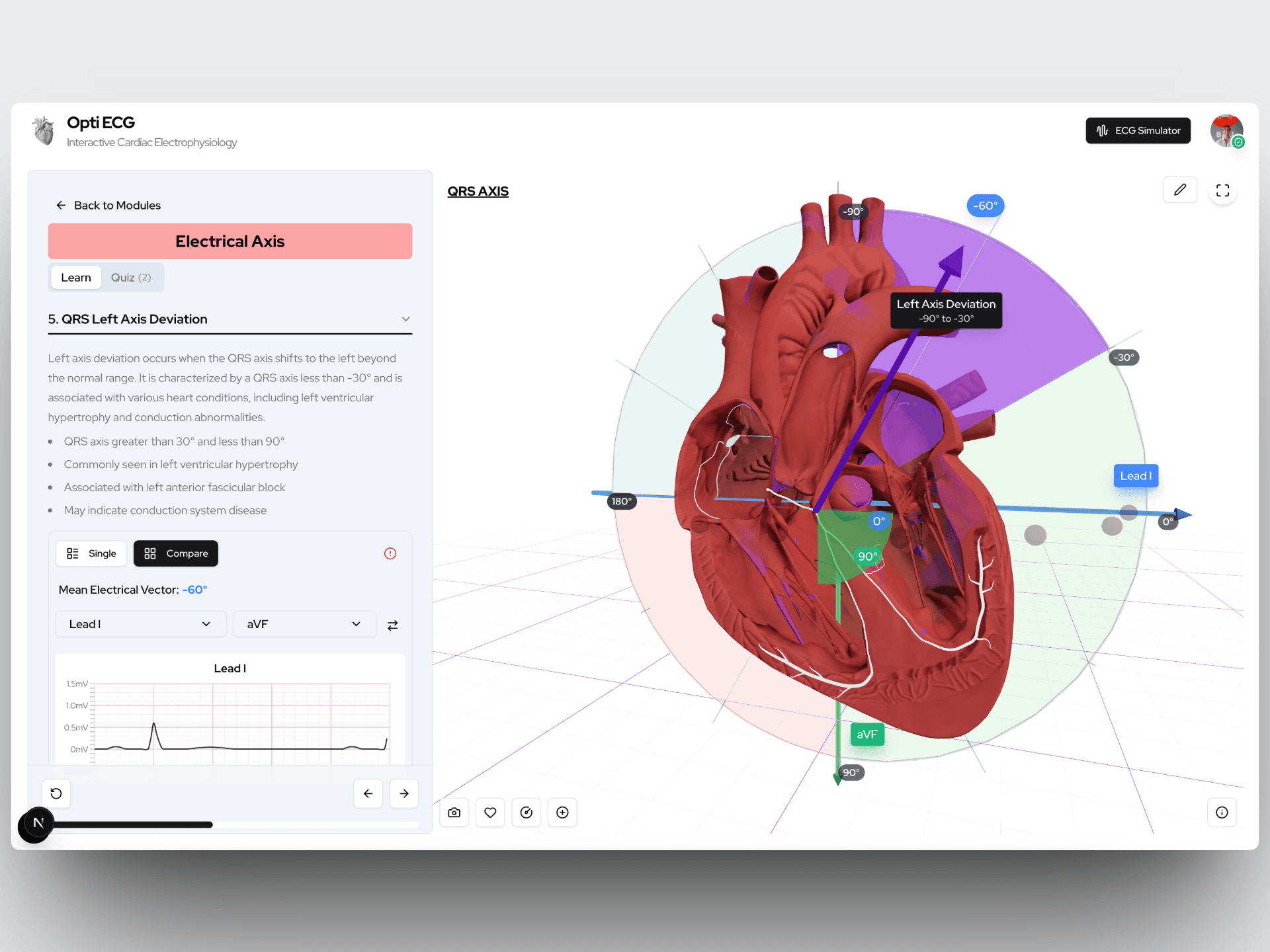
See Precordial Lead V5 in 3D
Explore ECG rhythms interactively with our simulator and 3D heart visualization synced beat-for-beat. See how electrical activity produces every wave on the tracing.
Related Topics
How helpful was this page?