Also known as: RAD, Right QRS Axis Deviation, Rightward Axis
Axis Properties
| Normal Range | -30° to +90° (human normal); RAD is defined as more positive than +90° |
| Deviation Direction | Rightward and inferior (axis range: +90° to +180°) |
ECG Criteria
- Lead I: negative QRS (dominant S wave)
- Lead aVF: positive QRS (dominant R wave)
- Axis more positive than +90°
- Deep S wave in lead I with tall R wave in lead III (SI SIII pattern absent; S in I prominent)
- Dominant R wave in V1 may accompany RAD with RVH
- Right ventricular strain pattern: ST depression and T-wave inversion in V1-V3 (with RVH)
Causes
- Right ventricular hypertrophy (most clinically important cause)
- Pulmonary hypertension and cor pulmonale
- Left posterior fascicular block (rare)
- Lateral myocardial infarction (loss of lateral left ventricular forces)
- Wolff-Parkinson-White syndrome (left-sided accessory pathways)
- Dextrocardia
- Left pneumothorax (shifts cardiac position)
- Chronic lung disease (COPD, emphysema)
- Atrial septal defect with volume overload
- Normal variant in children and young adults
- Lead misplacement (right arm/left arm reversal mimics RAD)
Clinical Significance
Right axis deviation is a significant finding that should prompt investigation for right ventricular pressure or volume overload. In the setting of dyspnea and tachycardia, RAD with right heart strain pattern raises concern for pulmonary embolism. Chronic RAD with RVH pattern suggests long-standing pulmonary hypertension or structural right heart disease. In young, asymptomatic patients, mild RAD can be a normal variant.
Species Variation
| Human (adult) | RAD: more positive than +90°; marked RAD: more positive than +120° |
| Canine | RAD in dogs: more positive than +100°; common with RVH in dirofilariasis |
| Feline | RAD in cats: more positive than +160° |
Frequently Asked Questions
What is the most important cause of right axis deviation to rule out?
Right ventricular hypertrophy from pulmonary hypertension is the most clinically significant cause of right axis deviation. In a patient with progressive dyspnea and RAD, evaluation should include echocardiography to assess right ventricular size and function, tricuspid regurgitation jet velocity (to estimate pulmonary arterial pressure), and investigation for pulmonary embolism or chronic lung disease.
Can lead misplacement cause apparent right axis deviation?
Yes. Reversal of the right arm and left arm electrodes is the most common lead misplacement error and produces a pattern that closely mimics right axis deviation: negative P and QRS in lead I, with normal-appearing lead II and III swapped. The key distinguishing feature is that lead aVR will appear positive (upright P and QRS) in arm lead reversal, which is rare in true right axis deviation. Always suspect misplacement before diagnosing RAD.
Is right axis deviation normal in children?
Yes. Right axis deviation is normal and expected in neonates and young children due to the physiologic right ventricular dominance present at birth. The axis gradually shifts leftward during the first years of life as the left ventricle grows to dominate. An axis up to +120° to +180° in a neonate is not concerning. By school age, normal adult axis ranges apply.
What is the S1Q3T3 pattern and how does it relate to right axis deviation?
The S1Q3T3 pattern (prominent S wave in lead I, Q wave in lead III, T-wave inversion in lead III) is classically associated with acute pulmonary embolism. It reflects acute right ventricular pressure overload. While it can be accompanied by right axis deviation, the S1Q3T3 pattern has modest sensitivity (~20%) and specificity for PE. Right axis deviation with sinus tachycardia in the right clinical setting should prompt urgent evaluation for PE regardless of whether S1Q3T3 is present.
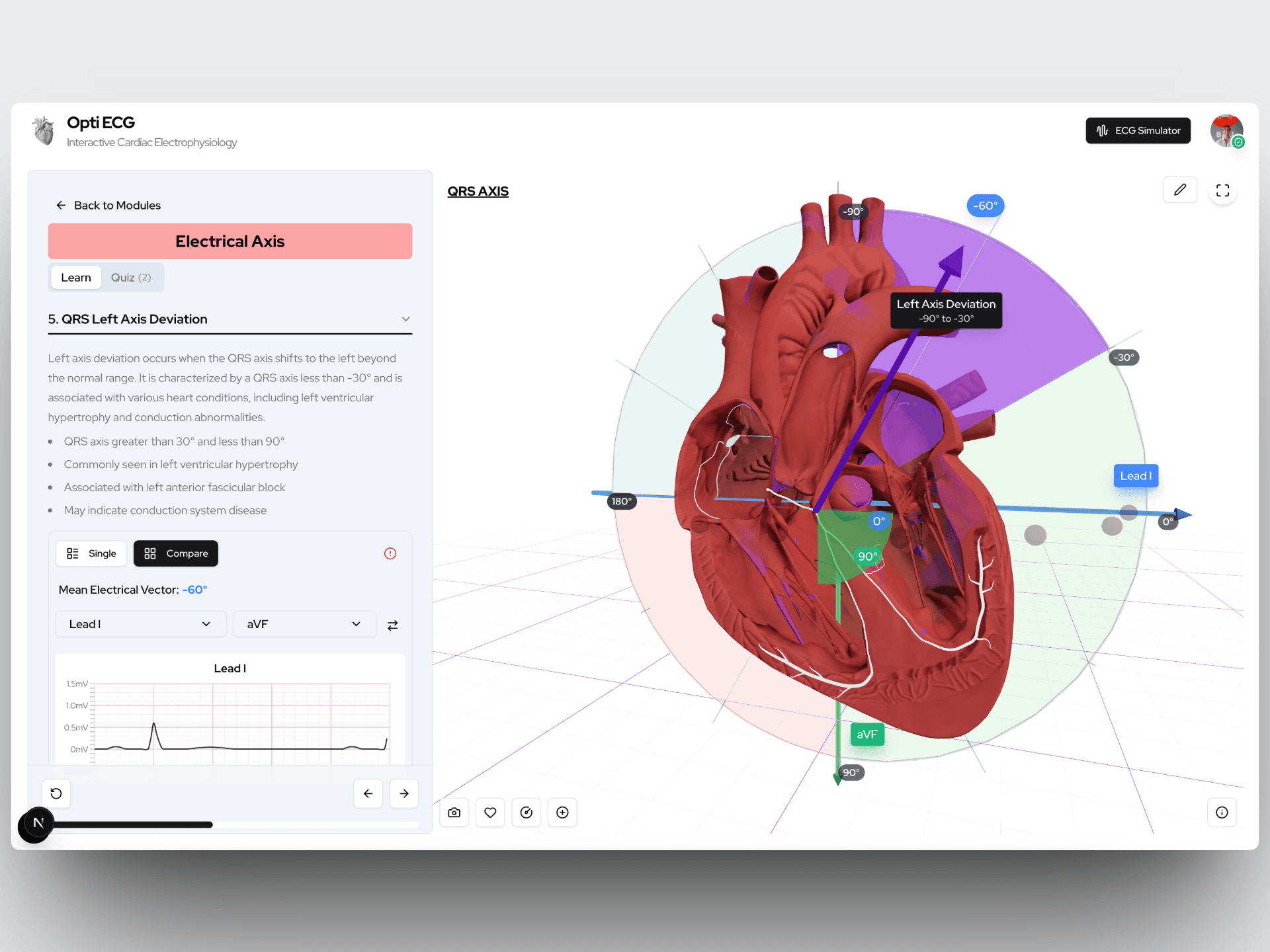
See Right Axis Deviation in 3D
Explore ECG rhythms interactively with our simulator and 3D heart visualization synced beat-for-beat. See how electrical activity produces every wave on the tracing.
Related Topics
How helpful was this page?