Also known as: Calculating QRS Axis, Electrical Axis Determination, Hexaxial Reference System, Cardiac Axis Method
Axis Properties
| Normal Range | Normal human axis: -30° to +90°; target of axis determination methods |
ECG Criteria
- Method 1 (Quadrant method): Assess leads I and aVF — both positive = normal quadrant (0° to +90°); I positive, aVF negative = superior left quadrant; I negative, aVF positive = inferior right quadrant; both negative = northwest quadrant
- Method 2 (Isoelectric lead method): Find the most isoelectric (equiphasic) limb lead — the axis is perpendicular to that lead, in the direction of the most positive deflection in the perpendicular lead
- Method 3 (Lead II check): If lead II is the tallest positive lead, the axis is approximately +60° (close to normal); if lead II is negative, suspect LAD
- Method 4 (Hexaxial system): Measure net QRS deflection in mm in two perpendicular leads (e.g., leads I and aVF), plot on hexaxial reference, calculate vector angle
- Hexaxial lead angles: Lead I = 0°, Lead II = +60°, Lead III = +120°, aVR = -150°, aVL = -30°, aVF = +90°
Causes
- Cardiac axis determination is a method, not a pathology — it identifies the direction of dominant ventricular forces
- The axis reflects the net vector sum of all ventricular depolarization wavefronts
- Influenced by: ventricular mass, conduction pathway, beat origin, body habitus
Clinical Significance
Accurate cardiac axis determination is essential for identifying fascicular blocks, ventricular hypertrophy, myocardial infarction patterns, and rhythm abnormalities. The axis is an integrative measure — it reflects the net balance of all ventricular electrical forces and can reveal localized conduction disease or regional myocardial loss that might be missed on individual lead analysis.
Species Variation
| Human | Normal: -30° to +90°; hexaxial system applies directly |
| Canine | Normal: +40° to +100°; same hexaxial method; apply species-specific normal ranges |
| Feline | Normal: 0° to +160°; same method; wide normal range requires care to avoid over-calling deviations |
Frequently Asked Questions
What is the fastest way to determine the cardiac axis at the bedside?
The two-lead quadrant method using leads I and aVF is the fastest approach. Check whether each is predominantly positive (upright QRS) or predominantly negative (inverted QRS). Both positive: normal quadrant (0° to +90°). Lead I positive, aVF negative: superior left quadrant — check if axis is within normal (-30° to 0°) or represents LAD (beyond -30°). Lead I negative, aVF positive: right axis deviation (beyond +90°). Both negative: extreme/northwest axis deviation. This takes seconds and identifies the axis quadrant reliably.
How do I use the isoelectric lead to find the precise axis?
Scan the six frontal plane limb leads (I, II, III, aVR, aVL, aVF) and identify the lead whose QRS is most isoelectric — meaning the positive and negative deflections are approximately equal, or the QRS is nearly flat. The mean cardiac axis lies perpendicular to that lead. Then look at the two leads that are perpendicular to the isoelectric lead and determine which shows the more positive deflection — the axis points toward that lead. Example: if aVL (at -30°) is isoelectric, the axis is perpendicular to -30°, meaning approximately +60° or -120°. Lead II (at +60°) being positive confirms the axis is +60°.
What is the hexaxial reference system?
The hexaxial reference system is a diagram representing the six frontal plane leads arranged at their anatomical angles, all intersecting at a central point representing the heart. Lead I is at 0°, lead II at +60°, lead III at +120°, aVF at +90°, aVL at -30°, and aVR at -150°. By measuring the net QRS amplitude in any two leads and plotting those values as vectors, the resultant angle (the cardiac axis) can be calculated. In practice, the isoelectric method provides sufficient precision without formal calculation.
Does the cardiac axis apply to P waves and T waves as well?
Yes. While QRS axis (ventricular depolarization) is the primary clinical axis measurement, P-wave axis (atrial depolarization) and T-wave axis (ventricular repolarization) can also be calculated using the same hexaxial method. Normal P-wave axis is 0° to +75° (upright P in I and II). T-wave axis normally aligns within 45° of the QRS axis; a wide QRS-T angle (>45°) suggests repolarization abnormality such as LV or RV strain. Abnormal P-wave axis raises questions about ectopic atrial rhythm.
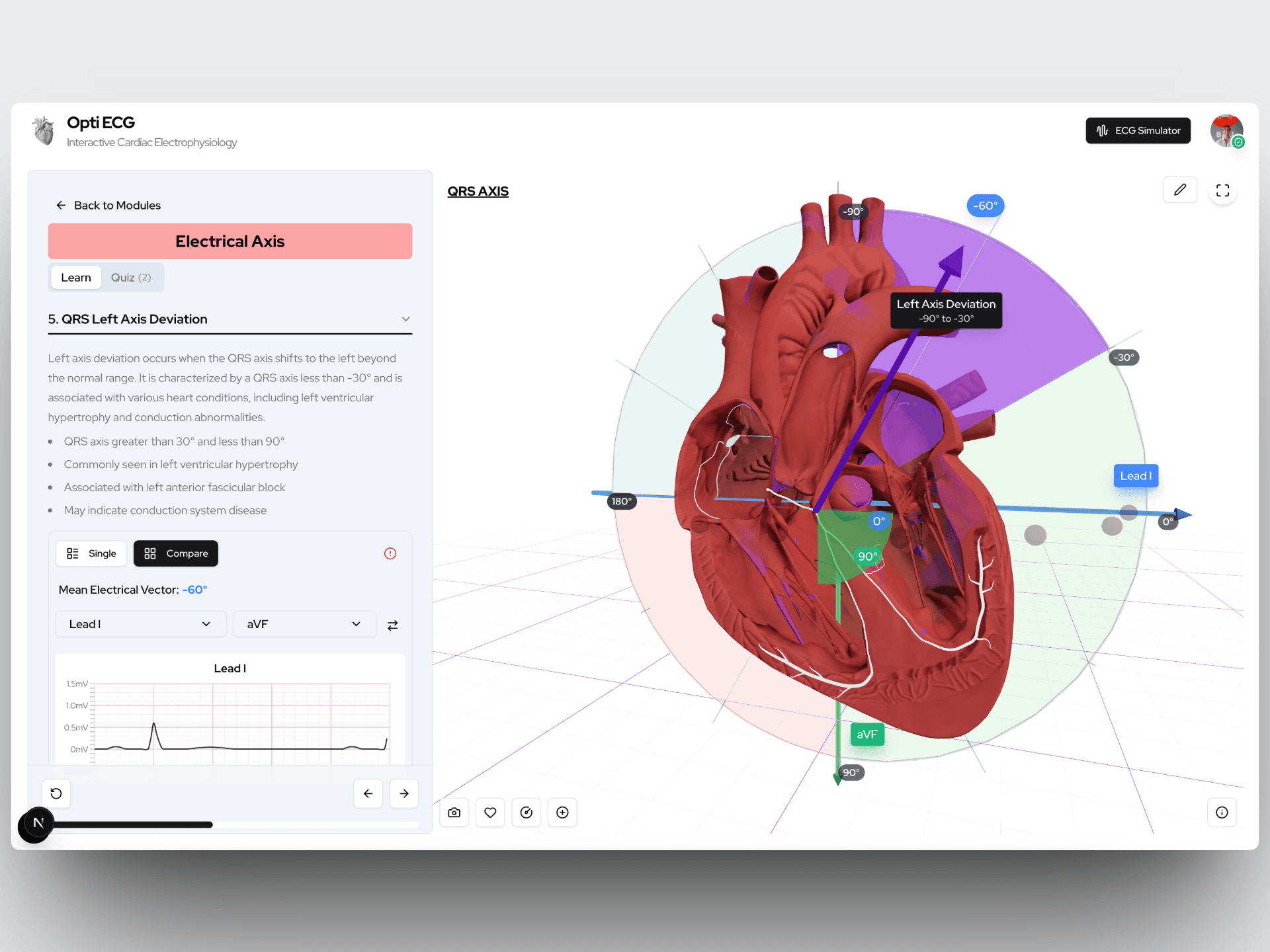
See How to Determine Cardiac Axis in 3D
Explore ECG rhythms interactively with our simulator and 3D heart visualization synced beat-for-beat. See how electrical activity produces every wave on the tracing.
Related Topics
How helpful was this page?