Also known as: LAD, Pathologic Left Axis, Left QRS Axis Deviation
Axis Properties
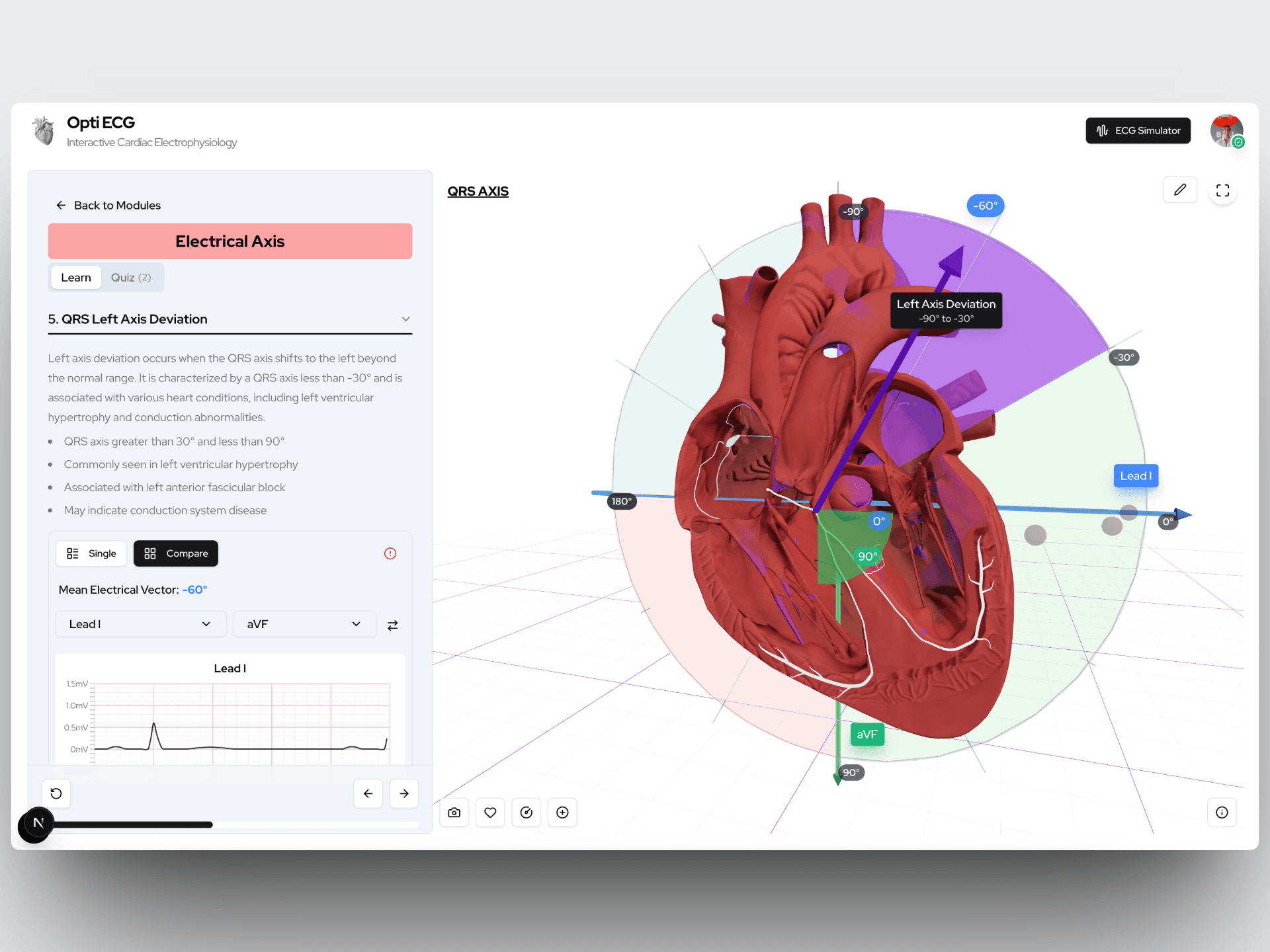
| Normal Range | -30° to +90° (human normal); LAD is defined as more negative than -30° |
| Deviation Direction | Superior and leftward (axis range: -30° to -90°) |
ECG Criteria
- Lead I: positive QRS (dominant R wave)
- Lead aVF: negative QRS (dominant S wave)
- Left anterior fascicular block pattern: rS in II, III, aVF with qR in I and aVL
- Axis more negative than -30° calculated by hexaxial reference system
- Isoelectric lead falls between aVF and lead II
- Lead II: often equiphasic or predominantly negative in marked LAD
Causes
- Left anterior fascicular block (most common cause of marked LAD)
- Left ventricular hypertrophy
- Inferior myocardial infarction (loss of inferior forces)
- Left bundle branch block (associated with LAD)
- Wolff-Parkinson-White syndrome (left-sided accessory pathway variants)
- Congenital heart disease (ostium primum ASD, tricuspid atresia)
- Hyperkalemia
- Ventricular pacing from right ventricular apex
- Normal variant in older adults and obese patients (horizontal heart position)
Clinical Significance
LAD may be a benign positional finding or the first sign of significant conduction disease. Left anterior fascicular block (LAFB) is the most common cause and carries low independent prognostic risk but often indicates underlying structural heart disease. LAD in the setting of inferior Q waves suggests prior inferior MI. When combined with right bundle branch block, LAD may indicate bifascicular block and elevated risk for complete heart block.
Species Variation
| Human | LAD: more negative than -30°; marked LAD: more negative than -45° |
| Canine | LAD in dogs: more negative than +40° (their leftward boundary) |
Frequently Asked Questions
What is the most common cause of left axis deviation?
Left anterior fascicular block (LAFB) is the most common cause of marked left axis deviation (more negative than -45°). It results from block in the anterior division of the left bundle branch, which shifts the dominant ventricular depolarization vector superiorly and leftward. LAFB produces the classic pattern of rS complexes in leads II, III, and aVF with qR complexes in leads I and aVL.
How negative must the axis be to call left axis deviation?
By conventional definition, left axis deviation begins at any axis more negative than -30°. Some sources use -45° as the threshold for 'marked' or 'significant' LAD, which more reliably predicts left anterior fascicular block. An axis between -30° and -45° may represent a borderline or indeterminate finding and should be interpreted with clinical context.
Does left axis deviation always indicate heart disease?
Not always. Mild left axis deviation (-30° to -45°) can occur as a positional variant in elderly, obese, or pregnant patients due to a horizontally oriented heart (diaphragm pushed upward). However, marked LAD (more negative than -45°) is almost always pathologic and warrants evaluation for left anterior fascicular block, inferior MI, or structural heart disease.
What is the significance of left axis deviation combined with right bundle branch block?
Left axis deviation (due to left anterior fascicular block) combined with right bundle branch block constitutes bifascicular block. Two of the three major fascicles — the right bundle branch and the left anterior fascicle — are non-functional. The remaining left posterior fascicle is sustaining conduction to the ventricles. Bifascicular block carries a risk of progression to complete (third-degree) AV block, particularly during acute myocardial infarction or in the setting of syncope.
See Left Axis Deviation in 3D
Explore ECG rhythms interactively with our simulator and 3D heart visualization synced beat-for-beat. See how electrical activity produces every wave on the tracing.
Related Topics
How helpful was this page?