Also known as: Northwest Axis, Indeterminate Axis, No Man's Land Axis, Superior Right Axis Deviation
Axis Properties
| Normal Range | -30° to +90° (human normal); extreme axis: -90° to ±180° |
| Deviation Direction | Superior and rightward (axis range: -90° to ±180°, the 'northwest' quadrant) |
ECG Criteria
- Lead I: negative QRS (dominant S or QS complex)
- Lead aVF: negative QRS (dominant S or QS complex)
- Both lead I and aVF negative — this defines the northwest quadrant
- Lead aVR: may be positive (upright QRS)
- Lead II: often negative or equiphasic
- Wide QRS frequently present (VT, pacing, hyperkalemia)
Causes
- Ventricular tachycardia (most common serious cause)
- Ventricular pacing (right ventricular apex pacing with high threshold or malposition)
- Severe right ventricular hypertrophy with right-axis rotation beyond +180°
- Lead misplacement (most common benign cause — right/left arm reversal plus other errors)
- Hyperkalemia with severe conduction disturbance
- End-stage cardiomyopathy
- Artificial cardiac rhythms with aberrant conduction
- Rare: left posterior fascicular block combined with left bundle branch block
Clinical Significance
Extreme axis deviation is always abnormal and requires immediate attention. In any patient with a wide-complex tachycardia and extreme axis deviation, ventricular tachycardia must be the primary diagnosis until proven otherwise. Lead misplacement should be excluded by checking limb lead morphology consistency. When confirmed in a hemodynamically stable patient with wide QRS, electrophysiology consultation is warranted.
Species Variation
| Human | Extreme axis: -90° to ±180°; always pathologic (or artifact) in adults |
| Canine | Extreme axis: negative lead I and aVF; rare, associated with severe RVH or VT |
Frequently Asked Questions
What does it mean when both lead I and aVF are negative?
When both lead I and aVF show predominantly negative QRS complexes, the mean cardiac axis lies in the northwest quadrant (-90° to ±180°), also called extreme or indeterminate axis deviation. This is always abnormal in adults and should prompt immediate consideration of ventricular tachycardia, severe conduction disease, ventricular pacing abnormality, or lead misplacement.
How do I distinguish extreme axis deviation from lead misplacement?
The most reliable distinguishing feature is the P-wave morphology. In true extreme axis deviation (e.g., VT), QRS morphology is often wide and bizarre. In right arm / left arm electrode reversal, P waves are inverted in lead I and aVR becomes upright — a combination that is physiologically impossible in any true rhythm. Checking for consistent lead progression across the precordial leads and clinical context (is the patient in VT?) are also essential steps.
Is extreme axis deviation ever a normal finding?
No. Extreme axis deviation (northwest axis) is never a normal finding in adult humans. If extreme axis deviation is found on a routine ECG without clinical symptoms or wide QRS, lead misplacement must be systematically excluded before attributing clinical significance. However, even after excluding artifact, the finding is pathologic and warrants cardiac evaluation.
What is the relationship between extreme axis deviation and ventricular tachycardia?
Ventricular tachycardia is the most clinically dangerous cause of extreme axis deviation. Ectopic foci in the ventricles can generate depolarization wavefronts that travel in directions entirely opposite to the normal His-Purkinje pathway, producing superior and rightward vectors. A wide-complex tachycardia with northwest axis should be treated as VT and managed accordingly until the rhythm is definitively characterized.
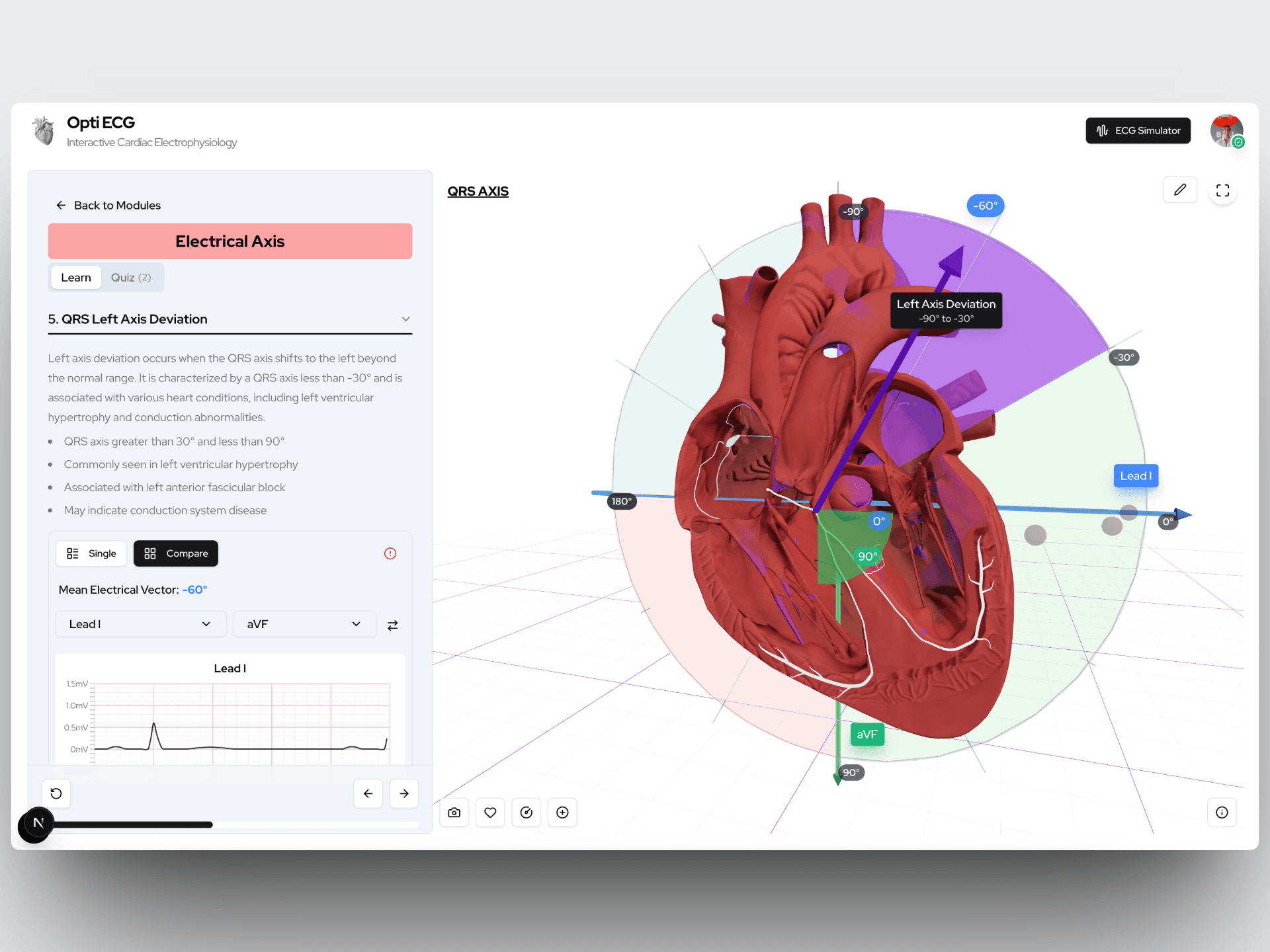
See Extreme Axis Deviation in 3D
Explore ECG rhythms interactively with our simulator and 3D heart visualization synced beat-for-beat. See how electrical activity produces every wave on the tracing.
Related Topics
How helpful was this page?