Also known as: How to Read a Veterinary ECG, Vet ECG Interpretation, ECG Reading for Veterinarians, Veterinary EKG Interpretation
| Topic Type | Interpretation |
| Species | canine, feline |
Key Differences from Human ECG
- Veterinary ECG interpretation requires species-specific reference ranges — the same numbers mean different things in a dog versus a cat versus a human
- The systematic interpretation sequence is the same as in human medicine (rate → rhythm → P waves → PR → QRS → ST → T wave) but each parameter has different normal thresholds
- Breed considerations are essential in dogs — a Great Dane ECG is interpreted differently from a Chihuahua ECG even within the canine normal range
- ST segment analysis in veterinary patients is complicated by the T wave morphology variability in dogs and the difficulty resolving the ST-T complex in cats
- QT interval correction formulas (QTc) for veterinary patients differ from the Bazett formula used in humans; veterinary-specific correction factors should be applied
- The clinical context (signalment, breed, history, physical examination) is even more critical in veterinary ECG interpretation because of the greater species and size variability
Clinical Pearls
- Follow a fixed systematic sequence every time: (1) rate, (2) rhythm regularity, (3) P wave identification and morphology, (4) PR interval, (5) QRS duration and morphology, (6) axis estimation, (7) ST-T wave analysis — this prevents missing secondary findings while focusing on the obvious abnormality
- Calculate heart rate from the ECG using the 1500-method (1500 divided by number of small boxes between R-R intervals at 25mm/s) — applicable to both dogs and cats but interpret against species-specific normals
- When identifying P waves is difficult in a cat at a fast rate, try increasing paper speed to 50mm/s or applying a vagal maneuver (gentle ocular pressure) to transiently slow the rate and unmask P waves
- Always measure intervals in lead II, which provides the most consistent view of the P wave and is the standard for interval measurement in veterinary ECG
- In a dog with an irregular rhythm, first determine whether the irregularity is patterned (Wenckebach, bigeminy) or completely random (AFib) — this distinction drives the diagnostic and treatment pathway
- Document your interpretation and attach the actual ECG strip to the medical record — subsequent clinicians need to see the original tracing, not just a written interpretation
Frequently Asked Questions
What is the systematic approach to interpreting a veterinary ECG?
A systematic veterinary ECG interpretation proceeds through seven steps. (1) Heart rate: calculate using the 1500/R-R interval method and compare to species- and size-appropriate normals. (2) Rhythm regularity: is the rhythm regular, regularly irregular, or irregularly irregular? (3) P waves: are they present, morphologically consistent, upright in lead II, and is there one before every QRS? (4) PR interval: measure in lead II and compare to species norms (dogs 0.06–0.13 s; cats 0.05–0.09 s). (5) QRS complex: measure duration and amplitude, assess morphology for bundle branch block patterns or ventricular origin. (6) Electrical axis: estimate from leads I and aVF and compare to species norms. (7) ST segment and T wave: look for ST elevation or depression and T wave inversion, keeping in mind species-specific morphology.
How do I calculate heart rate from a veterinary ECG?
The most reliable method at 25mm/s paper speed is the 1500-method: count the number of small boxes (each = 0.04 seconds) between two consecutive R wave peaks and divide 1500 by that number. For example, if there are 12 small boxes between R waves, the heart rate is 1500/12 = 125 bpm. At 50mm/s paper speed, use 3000 instead of 1500 (since each small box represents 0.02 seconds). For irregular rhythms (RSA or AFib), calculate the rate over a 6-second or 10-second strip and multiply by 10 or 6 respectively to get an average rate. Compare the calculated rate to species-specific and size-appropriate normals.
What are the most common ECG interpretation mistakes in veterinary medicine?
The most common errors include: (1) Applying human normal values to veterinary patients — the single most impactful error, leading to over-diagnosis of bradycardia, axis deviation, and arrhythmia. (2) Misidentifying respiratory sinus arrhythmia in dogs as a pathological rhythm. (3) Failing to account for breed and body size when interpreting canine ECGs. (4) Over-relying on a normal ECG to exclude cardiac disease in cats (HCM frequently has a normal ECG). (5) Missing P waves by not examining the baseline carefully, leading to missed P mitrale, PACs, or AV block. (6) Not recording in the standard position (right lateral recumbency), making axis and interval measurements unreliable.
When should additional leads or monitoring be used in veterinary ECG?
A standard 6-lead limb recording (I, II, III, aVR, aVL, aVF) with a lead II rhythm strip is appropriate for most in-clinic ECG evaluations. Additional monitoring is indicated in specific situations: (1) Holter monitoring (24-hour ambulatory ECG) for evaluating intermittent arrhythmias (syncope, episodic weakness) not captured on a clinic ECG — particularly useful in Boxers suspected of ARVC, Dobermans, and Miniature Schnauzers with suspected sick sinus syndrome. (2) Continuous telemetry during hospitalization for patients with unstable arrhythmias or post-cardiac procedure monitoring. (3) Event monitors for very infrequent episodes. (4) Precordial leads (chest leads) may occasionally be useful for arrhythmia characterization in complex cases.
How do I differentiate artifact from true arrhythmia on a veterinary ECG?
Distinguishing artifact from true arrhythmia requires evaluating several features. True arrhythmias: have consistent QRS morphology within the rhythm (unless the arrhythmia itself alters QRS shape), the abnormality is reproducible on repeated recordings, other leads captured simultaneously show the same finding, and vagal maneuvers or repositioning do not resolve the pattern. Artifact: often appears in only one lead, has irregular or random timing unrelated to the cardiac cycle, produces deflections that are faster or morphologically impossible for cardiac tissue (sharp vertical lines, random spikes), disappears when the patient settles, and may correlate with breathing or movement. When in doubt, repeat the recording in a different position or lead configuration.
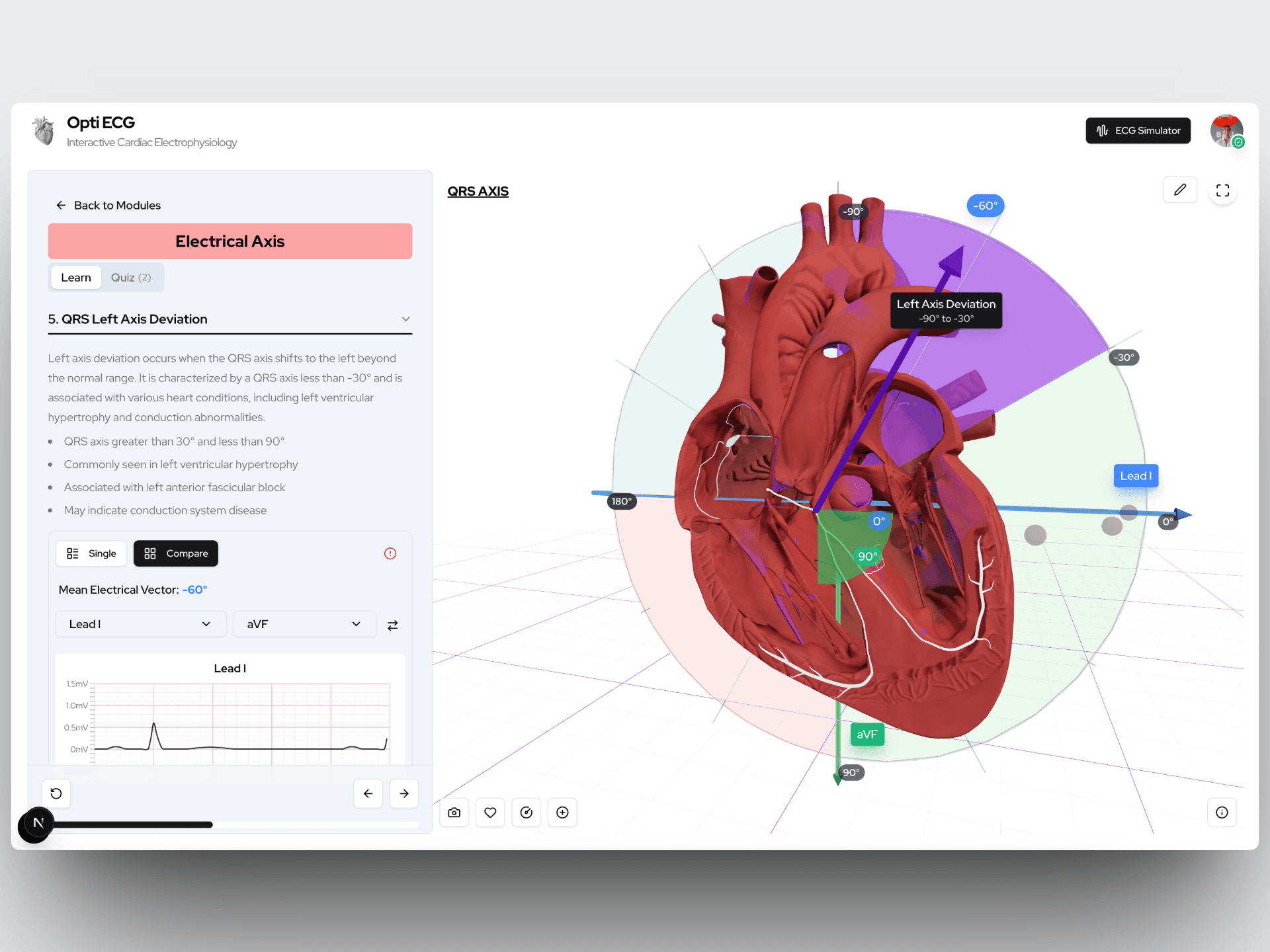
See Veterinary ECG Interpretation Guide in 3D
Explore ECG rhythms interactively with our simulator and 3D heart visualization synced beat-for-beat. See how electrical activity produces every wave on the tracing.
Related Topics
How helpful was this page?