Also known as: Dog ECG Electrode Placement, Canine EKG Lead Placement, Veterinary ECG Setup, Dog ECG Technique
| Topic Type | Technique |
| Species | canine |
Key Differences from Human ECG
- Dogs are recorded in right lateral recumbency (lying on their right side), not in the supine position used for human ECGs
- Limb electrodes are placed at the elbows (forelimbs) and stifles/flanks (hindlimbs), not on the distal extremities (paws)
- Alcohol gel or electrode gel is applied to the skin at contact points; excessive fur may need to be parted or lightly moistened — shaving is generally not required
- Alligator clips are the most common attachment method in veterinary practice; adhesive patches are less commonly used
- Precordial (chest) leads are not routinely recorded in dogs in general practice, though they can be obtained for arrhythmia characterization or vector analysis
- Lead II is the primary monitoring lead in veterinary practice for both rhythm analysis and measurement of intervals
Clinical Pearls
- Right lateral recumbency is the standard and all published normal canine ECG values are derived from this position — recording in other positions (standing, sternal) changes waveform morphology and makes reference range comparisons invalid
- Apply isopropyl alcohol directly to the fur/skin at electrode sites and allow it to penetrate for 10–15 seconds before attaching clips — this dramatically reduces baseline artifact without requiring shaving
- Color coding for leads follows the veterinary convention: Right forelimb = Red, Left forelimb = Yellow (or Black in some systems), Left hindlimb = Green, Right hindlimb = White (or Red in some systems) — always verify your specific machine's labeling
- If the baseline wanders excessively, check that the patient is not touching metal (cage bars, table edges) and that the handler is not grounding the patient through physical contact
- Muscle tremor artifact from patient shivering or anxiety is the most common cause of an uninterpretable ECG — allow time for the patient to settle, and use gentle restraint rather than forceful holds that increase muscle tension
- In brachycephalic dogs, upper airway noise during the recording can cause high-frequency artifact; open the airway by extending the neck gently or temporarily holding the mouth open
Frequently Asked Questions
Why are dogs positioned in right lateral recumbency for ECG recording?
Right lateral recumbency is the established veterinary standard position for canine ECG recording for two key reasons. First, all published normal value ranges for canine ECG parameters (P wave duration, QRS duration, R wave amplitude, PR interval, and electrical axis) were derived from recordings made in this position. Changing body position alters the relationship between the heart and the limb electrodes, shifting the electrical axis and waveform morphology in ways that cannot be reliably corrected. Second, right lateral recumbency tends to produce less patient anxiety than other restraint positions in most dogs, reducing muscle artifact.
Where exactly are the ECG electrodes placed on a dog?
For standard limb lead recording, electrodes are placed as follows: Right forelimb clip attaches at or just proximal to the right elbow (olecranon region) on the caudal aspect of the forelimb. Left forelimb clip attaches at the equivalent position on the left forelimb. Right hindlimb clip attaches at or just proximal to the right stifle (caudolateral aspect of the leg/flank region). Left hindlimb clip attaches at the equivalent position on the left hindlimb. Electrode gel or isopropyl alcohol is applied to improve skin contact. Alligator clips should grip skin and superficial tissue firmly but not so hard as to cause discomfort.
How do I reduce motion artifact and baseline wander on a canine ECG?
To reduce motion artifact: allow the patient to settle before recording (2–3 minutes minimum in lateral recumbency), use minimal restraint to reduce muscle tension, apply alcohol or gel to improve electrode contact, ensure clips do not pull or pinch uncomfortably, and record during a calm breathing phase. To reduce baseline wander: verify no metal contact between patient and table or cage, ensure the handler is not inadvertently grounding the circuit, check that all electrode connections are firm and the leads are not pulled taut, and ensure the examination table has a non-conductive surface or use a rubber mat. Low-frequency filter settings on the machine can also reduce baseline wander but may alter ST segment morphology.
Does the position of ECG electrodes affect the interpretation?
Yes, significantly. Moving electrodes from the standard positions (elbows and stifles in right lateral recumbency) changes the amplitude and morphology of all waveforms and shifts the calculated mean electrical axis. For example, recording with the patient standing rather than in lateral recumbency shifts the cardiac axis and alters QRS morphology in all leads. Placing electrodes more distally (on the paws) changes lead vectors. These modifications make published normal ranges inapplicable. If non-standard positioning is used for clinical reasons, this must be noted on the ECG report and interpretations must be made cautiously.
Do I need to shave the dog to get a good ECG signal?
Shaving is not routinely required or recommended for canine ECG recording. In most dogs, applying isopropyl alcohol (70%) or ECG electrode gel to the fur at the clip sites and pressing the clip firmly provides adequate electrical contact. Allow the alcohol to penetrate the fur for 10–15 seconds before attaching the clip. In dogs with very thick coats or heavily keratinized skin, parting the fur to place the clip directly against skin may improve signal quality. Shaving should be reserved for situations where repeated long-term monitoring is needed (such as Holter monitor application) or when signal quality remains unacceptable despite other measures.
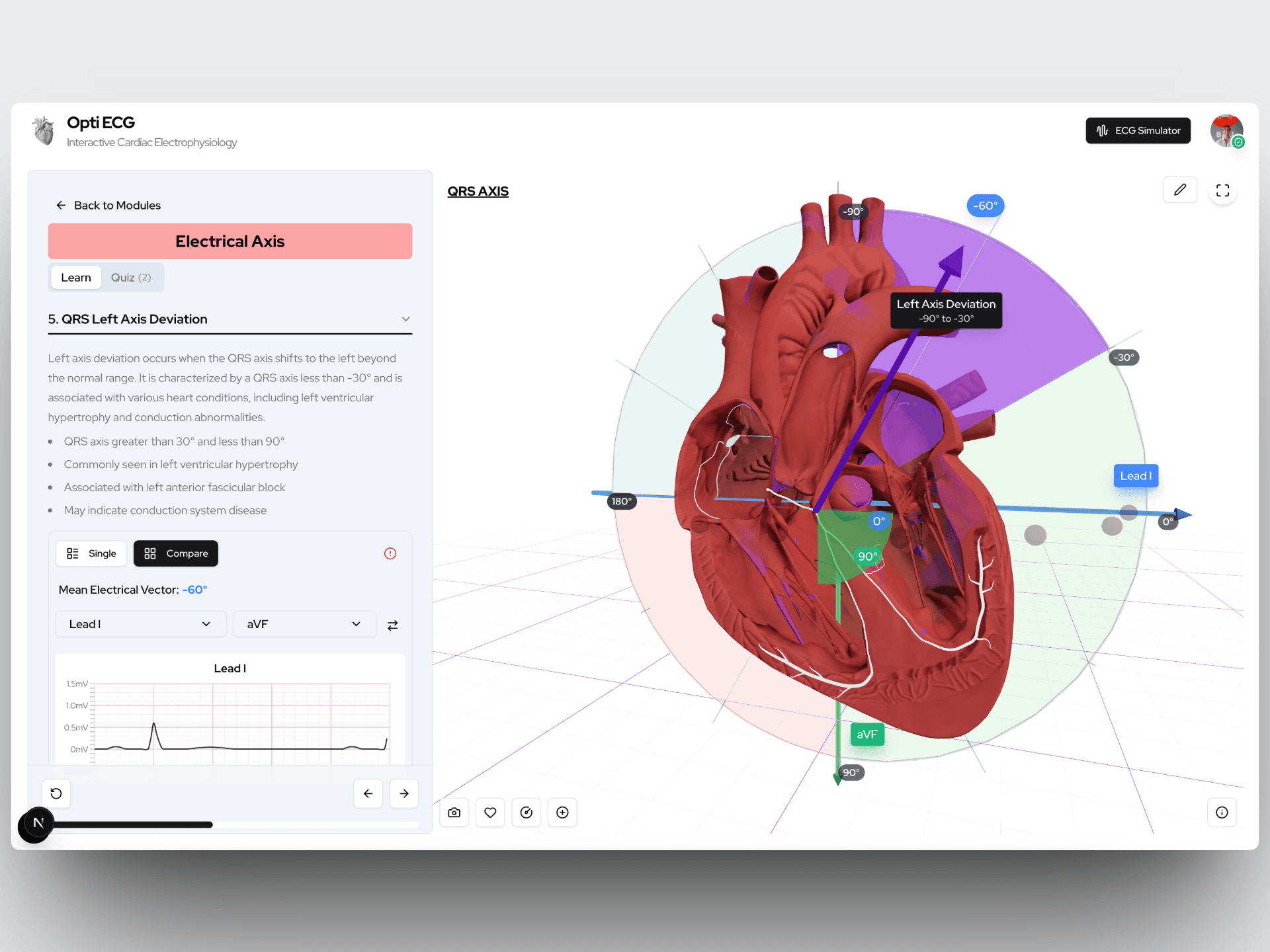
See Canine ECG Lead Placement in 3D
Explore ECG rhythms interactively with our simulator and 3D heart visualization synced beat-for-beat. See how electrical activity produces every wave on the tracing.
Related Topics
How helpful was this page?