Also known as: V4, Chest Lead 4, Precordial Lead 4
Lead Properties
| Lead Type | Precordial |
| Placement | Positive electrode at the fifth intercostal space, midclavicular line (MCL). This corresponds approximately to the cardiac apex in most adults. V4 serves as the anatomical landmark for the placement of V5 (anterior axillary line) and V6 (midaxillary line) at the same horizontal level. |
| View of Heart | Apical and mid-anterior left ventricle. V4 typically shows the largest overall QRS amplitude in the precordial leads and faces the cardiac apex — the final portion of the left ventricle to depolarize in normal sequence. |
| Clinical Use | Diagnosing anterior and apical MI, evaluating R-wave progression and transition zone, contributing to LVH voltage criteria, and assessing apical hypertrophic cardiomyopathy. V4 is often where the tallest R wave appears in normal ECGs. |
Normal Findings
- Predominantly positive QRS — R wave dominant (R > S)
- Tall R wave, often the tallest in the precordial leads
- Upright T wave
- Small or absent Q wave (lateral septal activation)
- QRS duration < 0.12 s
- Normal R-wave progression: r wave in V4 larger than V3 and smaller than V5
Abnormal Findings
- ST elevation in anterior or apical STEMI
- Loss of R wave or QS pattern in anterior MI
- Apical hypertrophic cardiomyopathy (HCM): giant T-wave inversions in V4–V6 (Yamaguchi pattern)
- Decreased R-wave amplitude relative to V3 (reverse R-wave progression, suggesting prior anterior MI)
- Poor R-wave progression at V4 (R still small, suggesting anterior MI or diffuse cardiomyopathy)
- ST depression in subendocardial ischemia
Frequently Asked Questions
Why is V4 considered the apical reference lead?
V4 is placed at the fifth intercostal space along the midclavicular line — a position that overlies the cardiac apex in most adults. The cardiac apex is the anatomical tip of the left ventricle, the final segment to undergo depolarization in the normal sequence. This anatomical proximity makes V4 the reference landmark for the remaining lateral precordial leads: V5 is placed horizontal to V4 at the anterior axillary line, and V6 is placed horizontal to V4 at the midaxillary line. Correct V4 placement is therefore essential for accurate positioning of V5 and V6.
What is the giant T-wave inversion pattern in V4 and what does it indicate?
Giant T-wave inversions in V4–V6 (and sometimes V3), often measuring 10 mm or more in depth, are the hallmark of apical hypertrophic cardiomyopathy (HCM) — also known as Yamaguchi syndrome. This variant of HCM involves hypertrophy predominantly of the cardiac apex rather than the septum. The ECG pattern can be striking and may be misidentified as Wellens syndrome or anterior ischemia. Echocardiography or cardiac MRI typically shows the spade-shaped left ventricular cavity with apical obliteration, and the prognosis differs from obstructive HCM.
How is V4 used to distinguish anterior from apical ST elevation?
In anterior STEMI from proximal LAD occlusion, ST elevation typically spans V1 through V4 or even V5, indicating a large territory involving the anterior wall and apex. When ST elevation is isolated to V4–V6 without V1–V2 involvement, an apical or mid-LAD occlusion or a diagonal branch occlusion is more likely. The distribution of ST elevation across the precordial leads — from which leads are involved and which are spared — helps localize the culprit artery and estimate the amount of myocardium at risk.
Can V4 placement errors affect the ECG significantly?
Yes — V4 placement errors have a downstream effect on V5 and V6, since both of those leads are placed horizontal to V4. If V4 is placed too high (e.g., at the fourth intercostal space), V5 and V6 will also be high, which can artificially alter R-wave progression, T-wave morphology, and ST findings in the lateral leads. Studies show that electrode misplacement is common in clinical practice and can lead to false diagnoses of MI, LVH, or T-wave abnormalities. Standardized training on limb and precordial lead placement is essential for reliable ECG interpretation.
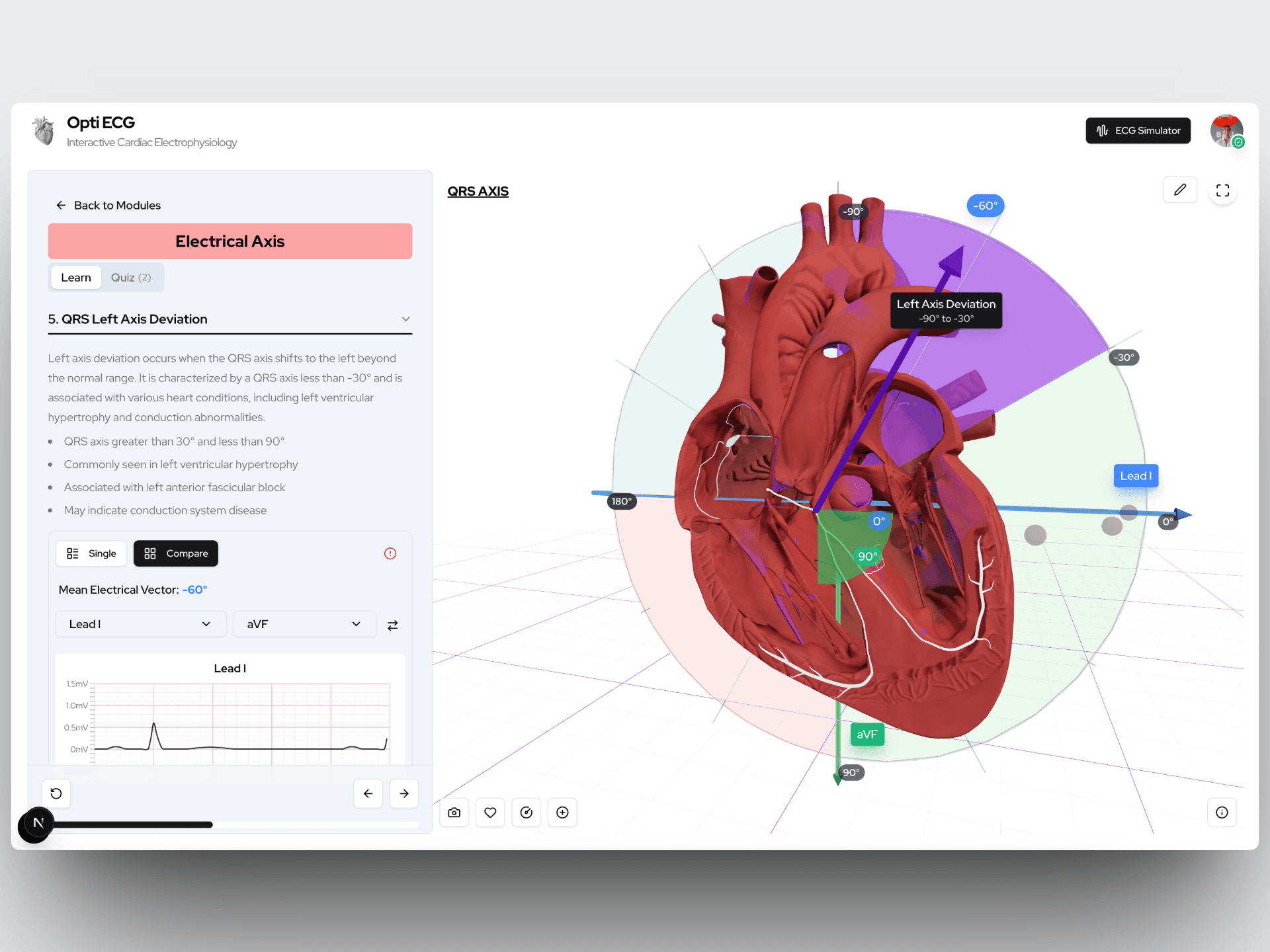
See Precordial Lead V4 in 3D
Explore ECG rhythms interactively with our simulator and 3D heart visualization synced beat-for-beat. See how electrical activity produces every wave on the tracing.
Related Topics
How helpful was this page?