Also known as: QRS Duration, Ventricular Depolarization Complex
Measurement
| Normal Range | Less than 0.12 seconds (120 ms) in adults. Values of 0.10–0.12s are considered borderline. A QRS duration of 0.12 seconds or greater indicates a bundle branch block or other intraventricular conduction delay. |
| Measurement | Measure from the earliest onset of the QRS complex (Q or R wave, whichever comes first) to the end of the S wave (the J point) in the lead where the QRS appears widest. Use multiple leads and take the widest measurement, as different leads may not capture the full extent of depolarization. |
Clinical Significance
QRS duration is a fundamental measure of ventricular conduction integrity. A narrow QRS confirms that ventricular activation is proceeding normally through the His-Purkinje system. QRS widening indicates either a bundle branch block, ventricular pre-excitation, pacemaker rhythm, or an ectopic ventricular rhythm. Wide QRS tachycardias require differentiation between ventricular tachycardia and supraventricular tachycardia with aberrant conduction, which has critical management implications.
Abnormalities
Left Bundle Branch Block (LBBB)
QRS duration of 0.12 seconds or greater with broad, notched R waves in lateral leads (I, aVL, V5-V6) and deep S waves or QS pattern in V1. The left ventricle depolarizes late via cell-to-cell spread rather than the Purkinje network, producing slow, asynchronous activation. LBBB is strongly associated with structural heart disease including cardiomyopathy, coronary artery disease, and hypertension.
Right Bundle Branch Block (RBBB)
QRS duration of 0.12 seconds or greater with an RSR' (rabbit ears) pattern in V1 and broad S waves in lateral leads (I, V5-V6). The right ventricle activates late via slow myocardial spread after the left ventricle has already depolarized normally. RBBB may be a normal variant in young adults but can also reflect right heart strain, pulmonary embolism, or ischemia.
Ventricular Tachycardia (VT)
Wide, bizarre QRS complexes at a rate typically greater than 100 bpm originating from an ectopic ventricular focus. Distinguishing VT from SVT with aberrancy is critical — findings favoring VT include AV dissociation, fusion beats, capture beats, concordance across precordial leads, and QRS width greater than 0.14s.
Hyperkalemia
Progressive QRS widening as serum potassium rises, reflecting slowed conduction through depolarized ventricular myocardium. Severe hyperkalemia produces a sinusoidal pattern as the P wave disappears and the QRS merges with the T wave. This is a life-threatening electrolyte emergency requiring emergent treatment.
Pre-excitation (WPW Syndrome)
QRS widening with a characteristic delta wave (slurred initial upstroke) due to early ventricular activation via an accessory pathway. The QRS is a fusion complex representing simultaneous conduction via the accessory pathway and the normal AV node-His-Purkinje system.
Frequently Asked Questions
What is the clinical importance of a wide QRS complex?
A wide QRS (greater than 0.12 seconds) indicates that ventricular depolarization is not following the normal rapid His-Purkinje pathway, which can be due to a bundle branch block, ventricular ectopic rhythm, pre-excitation, or metabolic/electrolyte disturbance such as hyperkalemia. The clinical significance depends heavily on context: isolated right bundle branch block may be benign, while new left bundle branch block in a patient with chest pain may indicate acute myocardial infarction and requires urgent evaluation.
How do you distinguish left from right bundle branch block on ECG?
The key lead is V1. In right bundle branch block, V1 shows an RSR' pattern (often described as rabbit ears) because the delayed right ventricular activation produces a second positive deflection. In left bundle branch block, V1 shows a wide QS or rS pattern with the terminal conduction slow and directed leftward. In lateral leads like V6, LBBB produces a broad monophasic R wave, while RBBB produces a broad terminal S wave due to late rightward activation.
Can a narrow QRS originate from the ventricles?
Narrow QRS complexes originating from the ventricles are extremely rare. For a ventricular rhythm to produce a narrow QRS, the ectopic focus would need to be located at or very near the His-Purkinje network to allow rapid synchronized depolarization. In practice, narrow QRS complexes almost always indicate supraventricular origin, meaning the impulse is using the normal His-Purkinje system for ventricular activation.
What is a QRS notch or slur and when is it significant?
A notch in the QRS complex — an abrupt change in the slope of the waveform — can represent delayed activation of a segment of myocardium. The most clinically significant notch is the delta wave of pre-excitation (WPW), which represents early ventricular activation via an accessory pathway. Notches within the QRS can also appear in bundle branch blocks, hypertrophy patterns, and as normal variants in some leads. Context and the overall QRS morphology determine clinical significance.
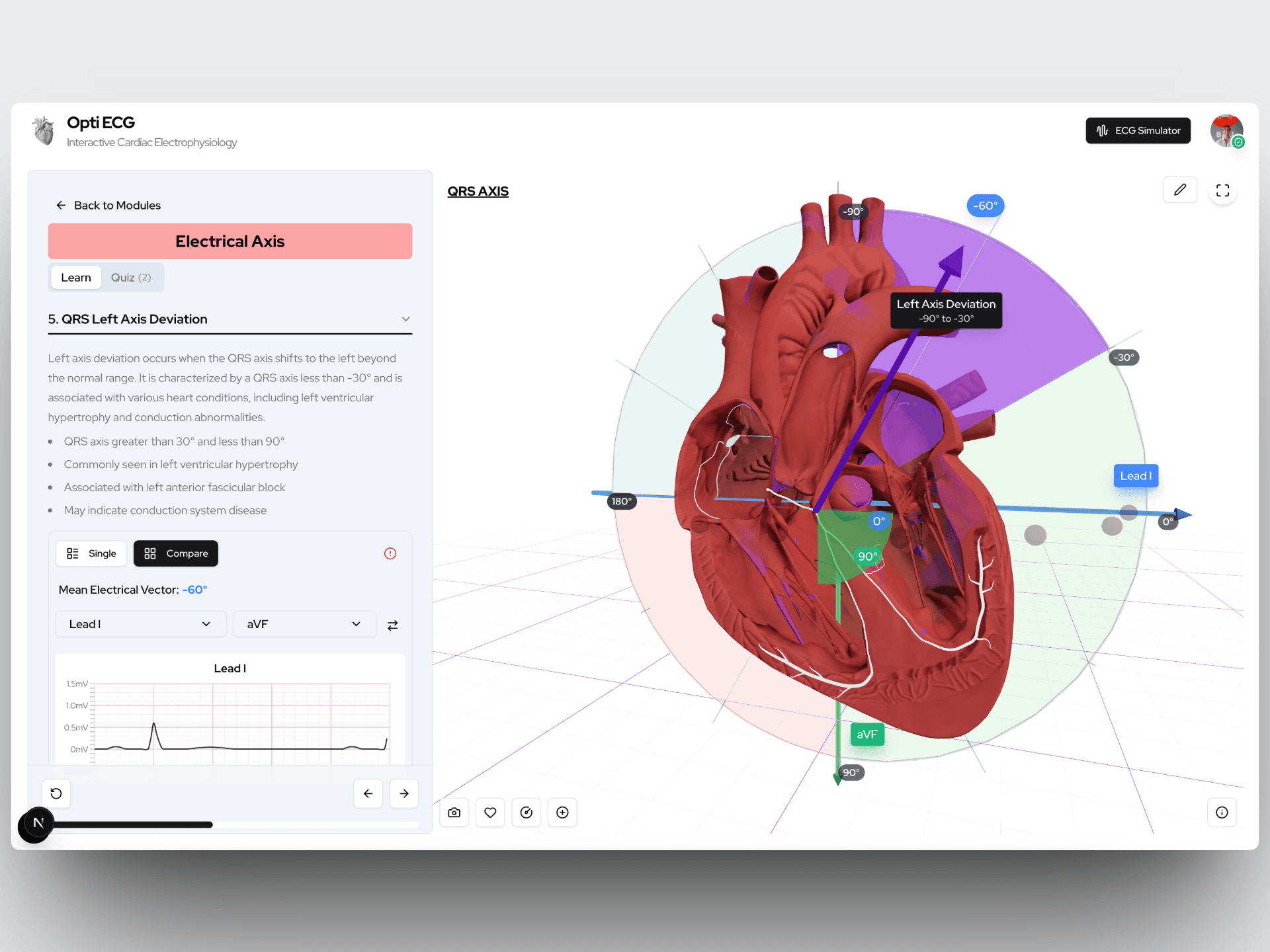
See QRS Complex in 3D
Explore ECG rhythms interactively with our simulator and 3D heart visualization synced beat-for-beat. See how electrical activity produces every wave on the tracing.
Related Topics
How helpful was this page?