Also known as: His Bundle, Atrioventricular Bundle, Common Bundle, AV Bundle
Anatomy & Physiology
| Location | The Bundle of His originates at the distal AV node, passes through the fibrous central body (central fibrous body) of the cardiac skeleton, and runs along the posterior-inferior border of the membranous interventricular septum before bifurcating into the right and left bundle branches at the top of the muscular interventricular septum. |
| Function | The Bundle of His bridges the electrical insulation of the fibrous cardiac skeleton to transmit the atrial impulse to the ventricles. It conducts the impulse rapidly from the AV node to the bundle branches and subsequently to the Purkinje fiber network, coordinating synchronous ventricular activation. The His bundle also contains subsidiary pacemaker cells capable of generating an escape rhythm at 40–60 bpm. |
| Conduction Velocity | 1.0–1.5 m/s |
| Blood Supply | Dual blood supply from both the AV nodal artery (from the RCA or LCx) and the first septal perforator of the left anterior descending artery (LAD). This dual supply makes isolated His bundle disease less common, though large anterior MIs can disrupt it. |
Clinical Relevance
Disease of the Bundle of His produces infranodal AV block, which is more serious than nodal block because the resulting escape rhythms are slower and less reliable. His bundle pacing is an emerging pacing technique in which the pacing lead is placed directly on the His bundle to deliver more physiological ventricular activation than traditional right ventricular apical pacing, preserving normal QRS morphology and left ventricular function.
Associated Pathologies
- Infranodal AV block
- Bifascicular block
- Trifascicular block
- His bundle tachycardia
- Concealed His bundle extrasystoles
Frequently Asked Questions
What is the Bundle of His and why does it matter?
The Bundle of His is a specialized conduction tract that forms the only normal electrical bridge between the AV node and the ventricles. Without it, the electrical impulse cannot pass from the atria to the ventricles through normal pathways. Disease at this level produces infranodal AV block, which tends to be more dangerous than AV nodal block because junctional escape rhythms are unreliable.
What is His bundle pacing?
His bundle pacing (HBP) is a physiological pacing technique where the pacing lead is placed directly on the Bundle of His. Because it stimulates the native conduction system rather than the ventricular muscle directly, it preserves a normal narrow QRS complex and more natural ventricular activation pattern. It is increasingly used as an alternative to right ventricular apical pacing to reduce the risk of pacing-induced cardiomyopathy.
How does the Bundle of His differ from the bundle branches?
The Bundle of His is the common undivided trunk of the ventricular conduction system, passing through the cardiac fibrous skeleton before bifurcating. The bundle branches are its two major divisions — the right bundle branch and the left bundle branch — that then distribute the impulse to each respective ventricle via the Purkinje fiber network.
What is an infranodal block?
Infranodal block refers to conduction failure below the AV node — within the Bundle of His, bundle branches, or Purkinje system. Infranodal Mobitz II and complete heart block with wide-complex escape rhythms (< 40 bpm) are examples. These are higher risk than nodal block because escape rhythms are slower, less stable, and may deteriorate to asystole without warning.
Can the Bundle of His act as a pacemaker?
Yes. Like the AV node, the Bundle of His contains latent pacemaker cells that can fire spontaneously at 40–60 bpm if the SA node and AV node both fail. This produces a His bundle escape rhythm with a narrow QRS (if the bundle branches are intact below the escape focus) or wide QRS (if there is also infranodal disease).
See Bundle of His in 3D
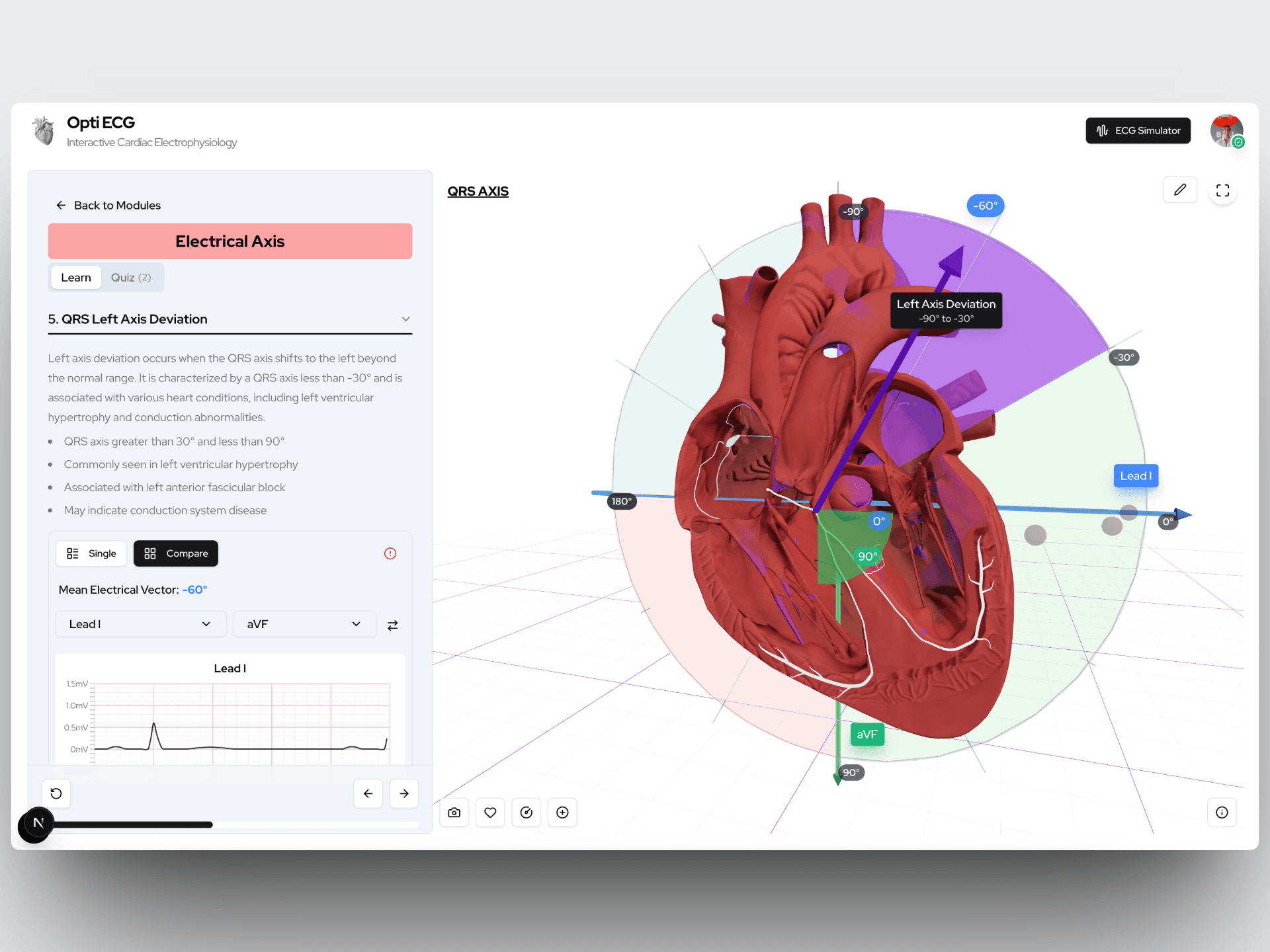
Explore ECG rhythms interactively with our simulator and 3D heart visualization synced beat-for-beat. See how electrical activity produces every wave on the tracing.
Related Topics
How helpful was this page?