Also known as: RBB, Right Branch of Bundle of His
Anatomy & Physiology
| Location | The right bundle branch descends along the right side of the interventricular septum beneath the endocardium, passing through the moderator band (septomarginal trabecula) to reach the anterior papillary muscle of the right ventricle before spreading into the subendocardial Purkinje fiber network. |
| Function | The right bundle branch rapidly conducts the depolarization impulse from the Bundle of His to the right ventricular endocardium, initiating right ventricular activation from the endocardium outward (endocardial-to-epicardial direction). This ensures synchronous, efficient right ventricular contraction. |
| Conduction Velocity | 2.0–4.0 m/s |
| Blood Supply | Primarily supplied by the first septal perforator branch of the left anterior descending artery (LAD). Because it has a single blood supply, the right bundle branch is more vulnerable to ischemic damage from anterior MI than the left bundle branch, which has dual supply. |
Clinical Relevance
Block of the right bundle branch produces RBBB, characterized on ECG by a QRS duration > 120 ms, a wide S wave in leads I and V6, and an RSR' ('rabbit ears') pattern in V1. RBBB may occur in isolation as a normal variant or with right heart disease, pulmonary embolism, anterior MI, myocarditis, or right ventricular pressure/volume overload. Incomplete RBBB (QRS 100–119 ms with RBBB morphology) can be normal, particularly in young athletes.
Associated Pathologies
- Right bundle branch block (RBBB)
- Incomplete right bundle branch block
- Bifascicular block (RBBB + left anterior fascicular block)
- Bifascicular block (RBBB + left posterior fascicular block)
- Trifascicular block
- Brugada syndrome (RBBB pattern with ST elevation in V1–V3)
Frequently Asked Questions
What does right bundle branch block look like on ECG?
RBBB produces a QRS duration > 120 ms with a characteristic RSR' or 'rabbit ears' pattern in lead V1 (right-sided lead) and a wide, slurred S wave in leads I and V6. The terminal portion of the QRS is directed rightward and anteriorly because the right ventricle depolarizes last, after the left ventricle has already begun its activation via the intact left bundle branch.
Is right bundle branch block always pathological?
No. Isolated RBBB is often a normal variant, particularly in young individuals and athletes. It does not require treatment in the absence of symptoms or structural heart disease. However, new RBBB — especially in the setting of chest pain — may indicate anterior MI, pulmonary embolism, or myocarditis and warrants urgent evaluation.
What is bifascicular block involving the right bundle branch?
Bifascicular block refers to RBBB combined with block of either the left anterior fascicle (RBBB + LAFB) or the left posterior fascicle (RBBB + LPFB). RBBB + LAFB is the most common combination and produces RBBB morphology with left axis deviation (–45° to –90°). These patients are at risk of progressing to complete heart block if the remaining fascicle also fails.
What is the Brugada pattern and how does it relate to RBBB?
Brugada syndrome is a channelopathy (SCN5A sodium channel mutation) that produces a characteristic coved-type or saddle-back ST elevation in leads V1–V3 with an apparent RBBB pattern. However, the QRS abnormality in Brugada arises from impaired sodium channel function in the right ventricular outflow tract, not true anatomical RBBB. The distinction matters because Brugada syndrome carries a risk of sudden cardiac death from ventricular fibrillation.
Which coronary artery supplies the right bundle branch?
The right bundle branch is primarily supplied by the first septal perforator branch of the left anterior descending artery (LAD). Occlusion of the LAD in an anterior MI can therefore damage the right bundle branch and produce new RBBB, which is a poor prognostic sign indicating large infarct territory.
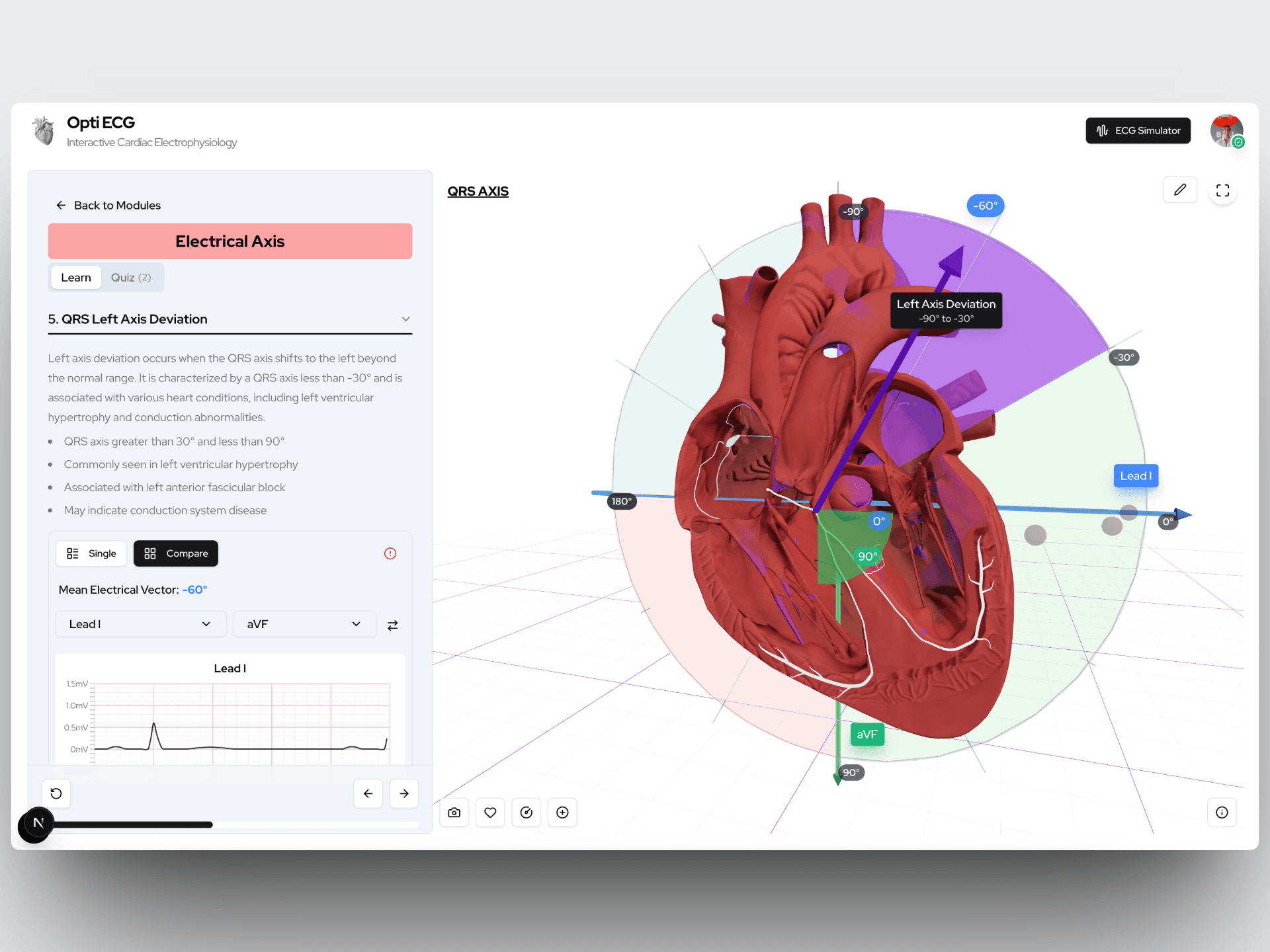
See Right Bundle Branch in 3D
Explore ECG rhythms interactively with our simulator and 3D heart visualization synced beat-for-beat. See how electrical activity produces every wave on the tracing.
Related Topics
How helpful was this page?