Also known as: LBB, Left Branch of Bundle of His
Anatomy & Physiology
| Location | The left bundle branch emerges from the Bundle of His at the crest of the muscular interventricular septum and fans across the left subendocardial surface of the septum. It typically divides into two main fascicles — the left anterior fascicle (LAF) and the left posterior fascicle (LPF) — and often gives off a septal fascicle that activates the interventricular septum from left to right. |
| Function | The left bundle branch activates the left ventricle from the endocardium outward and from apex to base, ensuring efficient, synchronous contraction of the dominant pumping chamber. The left bundle branch also initiates septal activation from left to right, producing the normal small septal Q waves in lateral leads (I, aVL, V5–V6). |
| Conduction Velocity | 2.0–4.0 m/s |
| Blood Supply | Dual blood supply from both the first septal perforator of the LAD (anterior) and from septal branches of the posterior descending artery (PDA) derived from the RCA or LCx (posterior). This dual supply makes isolated left bundle branch block less common from a single vessel occlusion. |
Clinical Relevance
LBBB is defined by QRS > 120 ms, broad monophasic R waves in leads I, aVL, V5–V6, and broad deep S waves or QS complex in V1. Unlike RBBB, LBBB is virtually always pathological, associated with coronary artery disease, cardiomyopathy, hypertensive heart disease, or aortic stenosis. New LBBB in a patient with chest pain should be treated as STEMI-equivalent (Sgarbossa criteria). LBBB also distorts ST segments and T waves, making ischemia assessment on ECG difficult. Cardiac resynchronization therapy (CRT) specifically targets LBBB by pacing both ventricles simultaneously to restore synchrony.
Associated Pathologies
- Left bundle branch block (LBBB)
- Incomplete left bundle branch block
- Ischemic cardiomyopathy
- Dilated cardiomyopathy
- Hypertensive heart disease
- Aortic stenosis
- LBBB-related dyssynchrony
Frequently Asked Questions
What does left bundle branch block look like on ECG?
LBBB produces a QRS duration > 120 ms with broad, monophasic R waves (no septal Q waves) in lateral leads I, aVL, V5, and V6, and a broad QS or rS pattern in V1. T waves are discordant — opposite in polarity to the terminal QRS deflection — which is a normal secondary change in LBBB and should not be mistaken for primary T wave abnormality.
Is left bundle branch block always serious?
Unlike RBBB, LBBB is virtually always associated with underlying structural or ischemic heart disease. It should not be dismissed as a benign incidental finding. In patients presenting with chest pain, new or presumed-new LBBB is treated as a STEMI-equivalent requiring urgent reperfusion evaluation using the Sgarbossa criteria to detect superimposed ischemia.
What are the Sgarbossa criteria?
The Sgarbossa criteria are ECG rules used to detect acute MI in the presence of LBBB, where normal ST analysis is distorted. The three criteria are: (1) ST elevation ≥ 1 mm concordant with the QRS direction (most specific, score 5); (2) ST depression ≥ 1 mm in leads V1–V3 concordant with negative QRS (score 3); and (3) ST elevation ≥ 5 mm discordant with negative QRS (less specific, score 2). A total score ≥ 3 suggests acute MI.
What is cardiac resynchronization therapy (CRT)?
CRT is a pacing technique that delivers simultaneous or near-simultaneous pacing to both ventricles (biventricular pacing) to restore synchronous contraction in patients with LBBB and reduced ejection fraction (EF < 35%). LBBB causes dyssynchrony — the right ventricle contracts before the left — reducing cardiac output and causing adverse remodeling. CRT reverses this dyssynchrony, improving ejection fraction, symptoms, and survival.
Why does LBBB cause loss of septal Q waves?
Normally, the left bundle branch activates the interventricular septum from left to right first, producing small septal Q waves in lateral leads. When the left bundle branch is blocked, septal activation occurs from right to left (driven by the right bundle branch instead), reversing this initial vector. As a result, the small septal Q waves that normally appear in leads I, V5, and V6 disappear, replaced by a broader initial R wave.
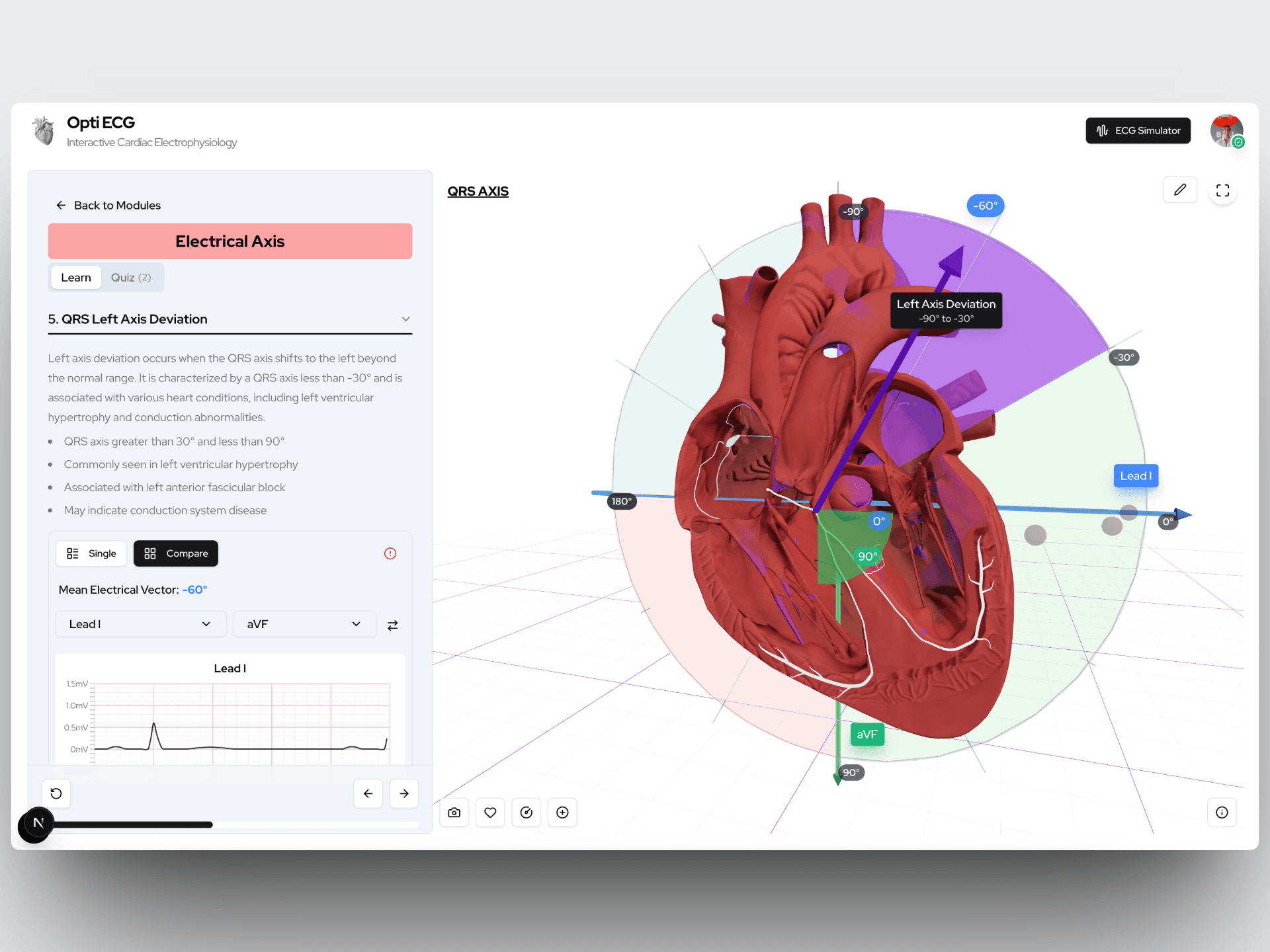
See Left Bundle Branch in 3D
Explore ECG rhythms interactively with our simulator and 3D heart visualization synced beat-for-beat. See how electrical activity produces every wave on the tracing.
Related Topics
How helpful was this page?