Also known as: Complete Heart Block, CHB, 3rd Degree AV Block
ECG Characteristics
| Heart Rate | Atrial rate normal (60–100 bpm); ventricular escape rate 20–60 bpm depending on level of block |
| Rhythm | Both atrial and ventricular rhythms are independently regular (AV dissociation) |
| P Wave | Normal P waves present at their own rate, unrelated to QRS complexes |
| PR Interval | Completely variable — no relationship between P waves and QRS complexes |
| QRS Duration | Narrow if junctional escape (40–60 bpm); wide if ventricular escape (20–40 bpm) |
Mechanism
Complete interruption of conduction between the atria and ventricles. The atria are driven by the SA node while the ventricles are driven by a subsidiary pacemaker (junctional or ventricular escape rhythm).
Key Features on ECG
- Complete AV dissociation — P waves and QRS complexes are independent
- More P waves than QRS complexes
- Regular P-P intervals and regular R-R intervals but no relationship between them
- Escape rhythm rate depends on level of block
- P waves 'march through' QRS complexes at their own rate
Causes
- Conduction system fibrosis (idiopathic, age-related)
- Inferior MI (AV nodal block, usually temporary)
- Anterior MI (infranodal block, usually permanent)
- Congenital (associated with maternal lupus antibodies)
- Post-cardiac surgery or ablation
- Drug toxicity (digoxin, beta-blockers, calcium channel blockers)
Clinical Significance
Complete heart block is a medical emergency when newly acquired. The patient depends entirely on the escape rhythm for cardiac output. Temporary pacing is often needed acutely, and permanent pacemaker implantation is the definitive treatment for symptomatic or acquired complete heart block.
Frequently Asked Questions
What is AV dissociation in complete heart block?
AV dissociation means the atria and ventricles beat independently of each other. The SA node continues to pace the atria at a normal rate, but none of those impulses reach the ventricles. The ventricles rely on their own escape pacemaker. On ECG, you see P waves and QRS complexes at different rates with no consistent relationship.
Can complete heart block be temporary?
Yes. In inferior MI, complete heart block is usually due to AV nodal ischemia and often resolves within days as the ischemia resolves. In drug toxicity, it may reverse when the offending agent is discontinued. However, complete heart block from anterior MI or structural conduction system disease is usually permanent.
Is third-degree AV block common in dogs?
Third-degree AV block does occur in dogs and can be congenital or acquired. Congenital complete heart block is seen in some breeds. Acquired causes include fibrosis, myocarditis, and neoplasia. In dogs, it often presents with weakness, exercise intolerance, or syncope. Pacemaker implantation is the standard treatment for symptomatic dogs.
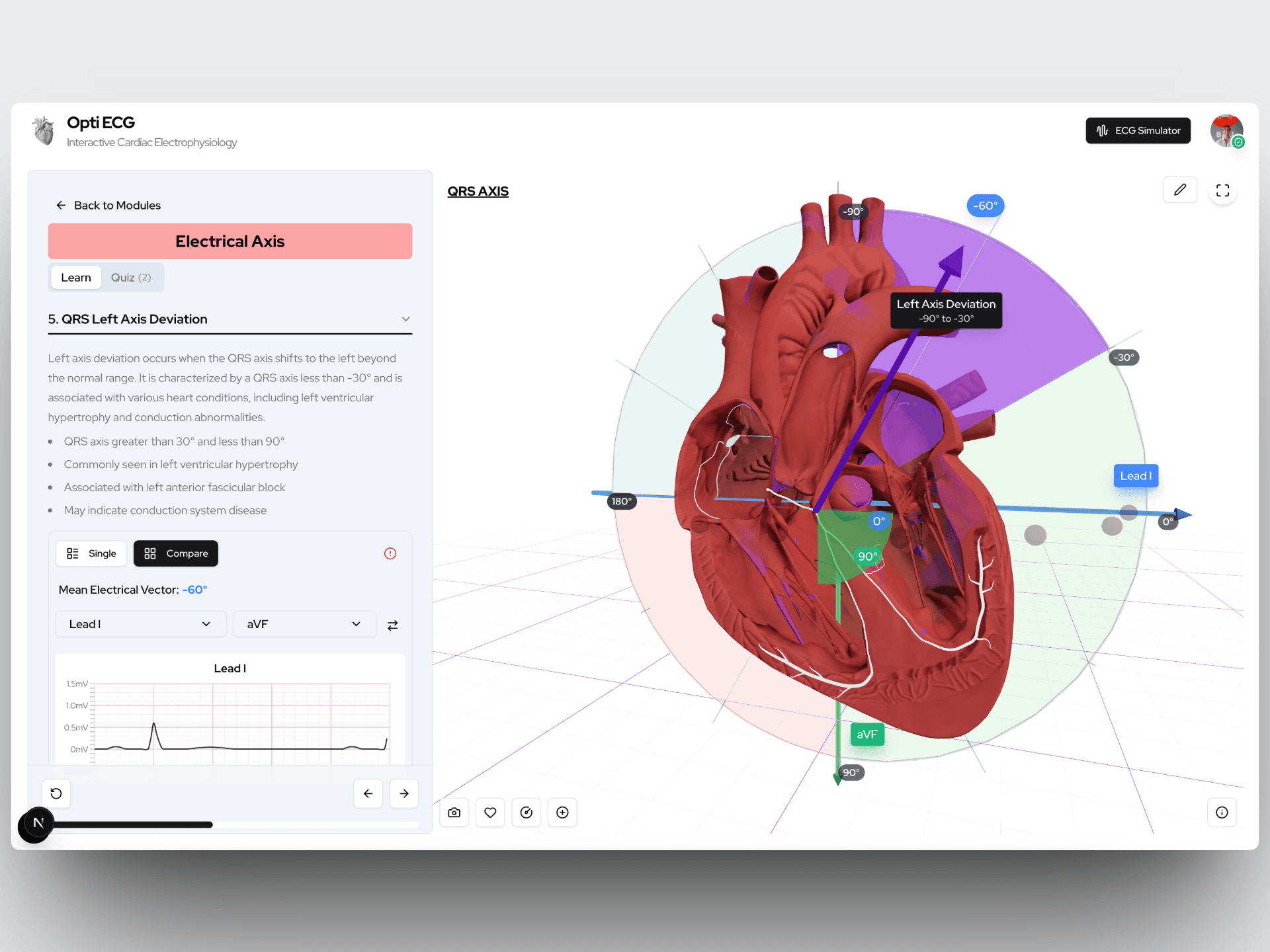
See Third-Degree AV Block in 3D
Explore ECG rhythms interactively with our simulator and 3D heart visualization synced beat-for-beat. See how electrical activity produces every wave on the tracing.
Related Topics
How helpful was this page?