Also known as: AV Node, Aschoff-Tawara Node, Junctional Node
Anatomy & Physiology
| Location | Located at the apex of the triangle of Koch in the right atrial septum, just above the tricuspid annulus and anterior to the coronary sinus ostium. It is a compact, ovoid structure approximately 5–7 mm long and 2–5 mm wide, positioned at the atrioventricular junction. |
| Function | The AV node performs three critical functions: (1) it delays the conduction impulse from the atria by approximately 100–200 ms, allowing atrial systole to complete ventricular filling before QRS onset; (2) it acts as a frequency filter, limiting the ventricular rate during rapid atrial arrhythmias such as atrial fibrillation and flutter; and (3) it serves as a subsidiary pacemaker at 40–60 bpm if higher pacemakers fail, producing a junctional escape rhythm. |
| Conduction Velocity | 0.05 m/s — the slowest conduction velocity in the heart, responsible for the PR interval delay |
| Blood Supply | AV nodal artery, which arises from the right coronary artery in approximately 85–90% of people (right-dominant circulation) and from the left circumflex artery in the remainder. Inferior MI with RCA occlusion is a common cause of acquired AV block. |
Clinical Relevance
The AV node is the most clinically important site of conduction disease. First-degree AV block (PR > 200 ms) reflects slowed nodal conduction. Second-degree Mobitz I (Wenckebach) block is typically nodal in origin with progressive PR lengthening and dropped beats. Mobitz II block is usually infranodal. Third-degree (complete) AV block requires emergency pacing. The AV node's rate-limiting function is therapeutically exploited by AV nodal blocking agents (beta-blockers, calcium channel blockers, digoxin, adenosine) to control ventricular rate in atrial fibrillation.
Associated Pathologies
- First-degree AV block
- Second-degree AV block — Mobitz I (Wenckebach)
- Second-degree AV block — Mobitz II
- Third-degree (complete) AV block
- Junctional escape rhythm
- Accelerated junctional rhythm
- AV nodal reentrant tachycardia (AVNRT)
- High-degree AV block
Frequently Asked Questions
Why does the AV node slow conduction?
The AV node conducts at only 0.05 m/s because its cells rely on slow calcium-dependent action potentials rather than the fast sodium-dependent potentials of working myocardium. This physiological delay of 100–200 ms creates the PR interval on ECG and ensures atrial systole completes ventricular filling before the QRS triggers ventricular contraction.
What is the difference between Mobitz I and Mobitz II AV block?
Mobitz I (Wenckebach) block shows progressive PR interval lengthening on each beat until a QRS is dropped, then the cycle resets. It is usually caused by disease within the AV node itself and is often benign. Mobitz II block shows a constant PR interval with sudden unexpected dropped QRS complexes and indicates infranodal disease (Bundle of His or bundle branches), which is more serious and often requires pacing.
What is AV nodal reentrant tachycardia (AVNRT)?
AVNRT is the most common paroxysmal supraventricular tachycardia. It occurs because the AV node has two functionally distinct pathways (fast and slow) that can form a reentry circuit. An impulse travels down one pathway and back up the other in a rapid cycle, producing a regular narrow-complex tachycardia at 150–250 bpm with P waves hidden in or just after the QRS complex.
What medications block the AV node?
AV nodal blocking agents include beta-blockers (metoprolol, atenolol), non-dihydropyridine calcium channel blockers (verapamil, diltiazem), digoxin, and adenosine. These are used therapeutically to slow the ventricular rate in atrial fibrillation and flutter, or to terminate AV-nodal-dependent reentry tachycardias. Adenosine transiently blocks the AV node completely and is used for acute SVT termination.
What is a junctional escape rhythm?
A junctional escape rhythm arises from AV nodal or His bundle pacemaker cells when the SA node fails or is suppressed. Its intrinsic rate is 40–60 bpm, and it produces a narrow QRS complex (unless aberrant conduction is present). P waves may be absent, retrograde (inverted in lead II), or occur after the QRS. It is a protective mechanism preventing asystole.
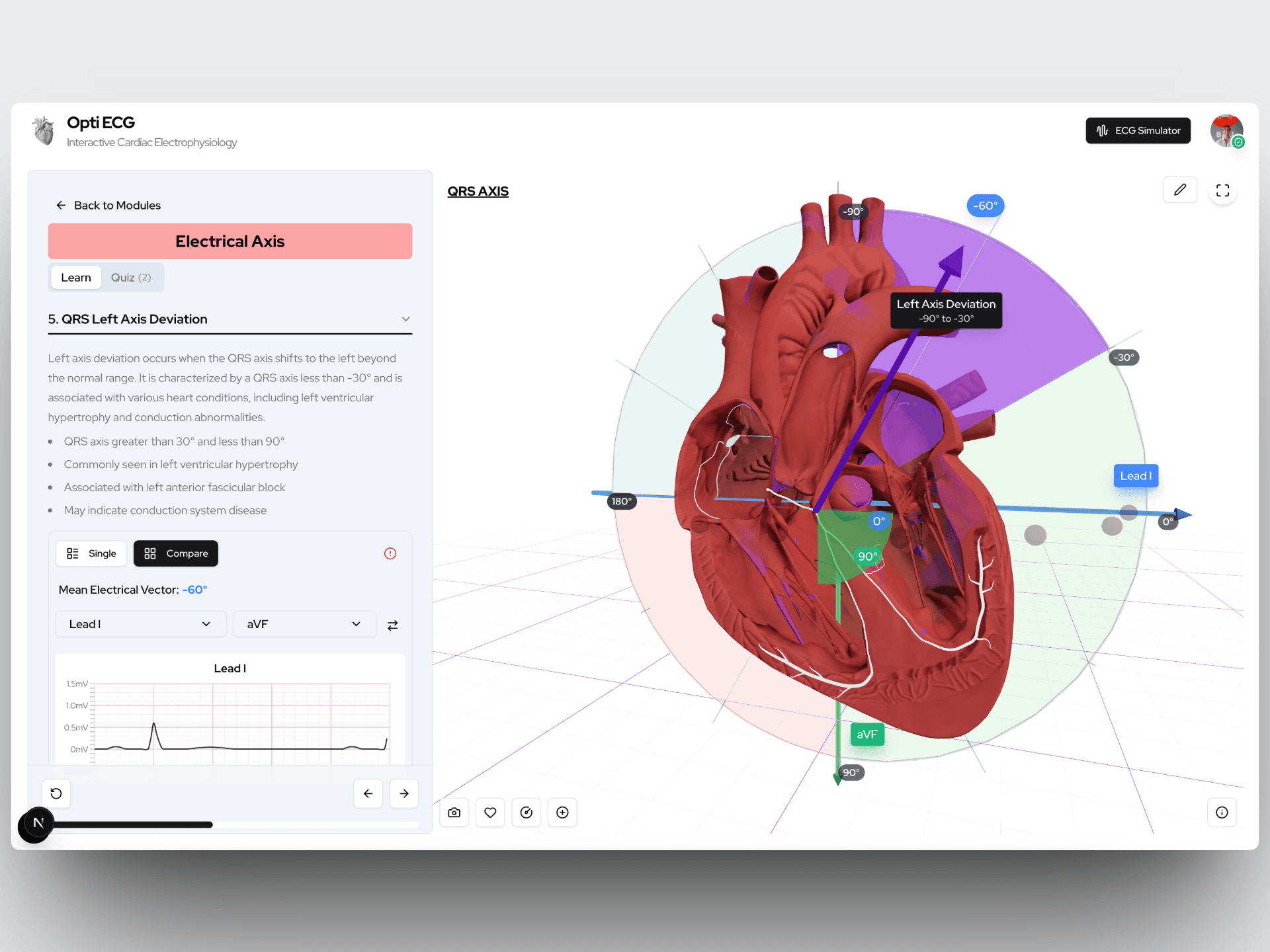
See Atrioventricular Node in 3D
Explore ECG rhythms interactively with our simulator and 3D heart visualization synced beat-for-beat. See how electrical activity produces every wave on the tracing.
Related Topics
How helpful was this page?