Also known as: SVT, PSVT, Paroxysmal SVT
ECG Characteristics
| Heart Rate | 150–250 bpm |
| Rhythm | Regular (abrupt onset and offset) |
| P Wave | P waves often absent or hidden in QRS/T wave; may be retrograde (inverted in inferior leads) |
| PR Interval | Depends on mechanism; short RP in AVNRT, long RP in atypical AVNRT |
| QRS Duration | < 0.12 seconds (narrow complex) |
Mechanism
Most commonly involves a re-entrant circuit within or around the AV node (AVNRT) or via an accessory pathway (AVRT). The circuit sustains itself with rapid, repetitive conduction.
Key Features on ECG
- Regular narrow complex tachycardia at 150–250 bpm
- Abrupt onset and offset (paroxysmal)
- P waves often absent or retrograde
- Pseudo-r' in V1 or pseudo-S in inferior leads (AVNRT)
- No beat-to-beat rate variation
Causes
- Re-entrant circuit (AVNRT most common, ~60%)
- Accessory pathway (AVRT/WPW, ~30%)
- Caffeine, alcohol, or stimulant triggers
- Stress or exercise
- Often occurs in young, otherwise healthy patients
Clinical Significance
SVT is generally not life-threatening but can be highly symptomatic (palpitations, lightheadedness, chest discomfort). Acute management includes vagal maneuvers and adenosine. Catheter ablation is curative in > 95% of cases.
Frequently Asked Questions
How is SVT terminated acutely?
First-line treatment includes vagal maneuvers (Valsalva maneuver, carotid sinus massage). If these fail, IV adenosine is given as a rapid bolus — it transiently blocks AV node conduction, breaking the re-entrant circuit. If adenosine fails, IV verapamil, diltiazem, or beta-blockers may be used.
What is the difference between AVNRT and AVRT?
AVNRT (AV nodal re-entrant tachycardia) uses dual pathways within the AV node itself — a slow pathway and a fast pathway. AVRT (AV re-entrant tachycardia) uses an accessory pathway outside the AV node (as in WPW syndrome) to create the re-entrant circuit. Both present similarly on ECG but have different ablation targets.
Can SVT occur in animals?
SVT occurs in dogs and cats, though it is less common than ventricular arrhythmias. Cats with hypertrophic cardiomyopathy may develop SVT. In dogs, SVT may be associated with structural heart disease or accessory pathways. Treatment principles are similar to human management.
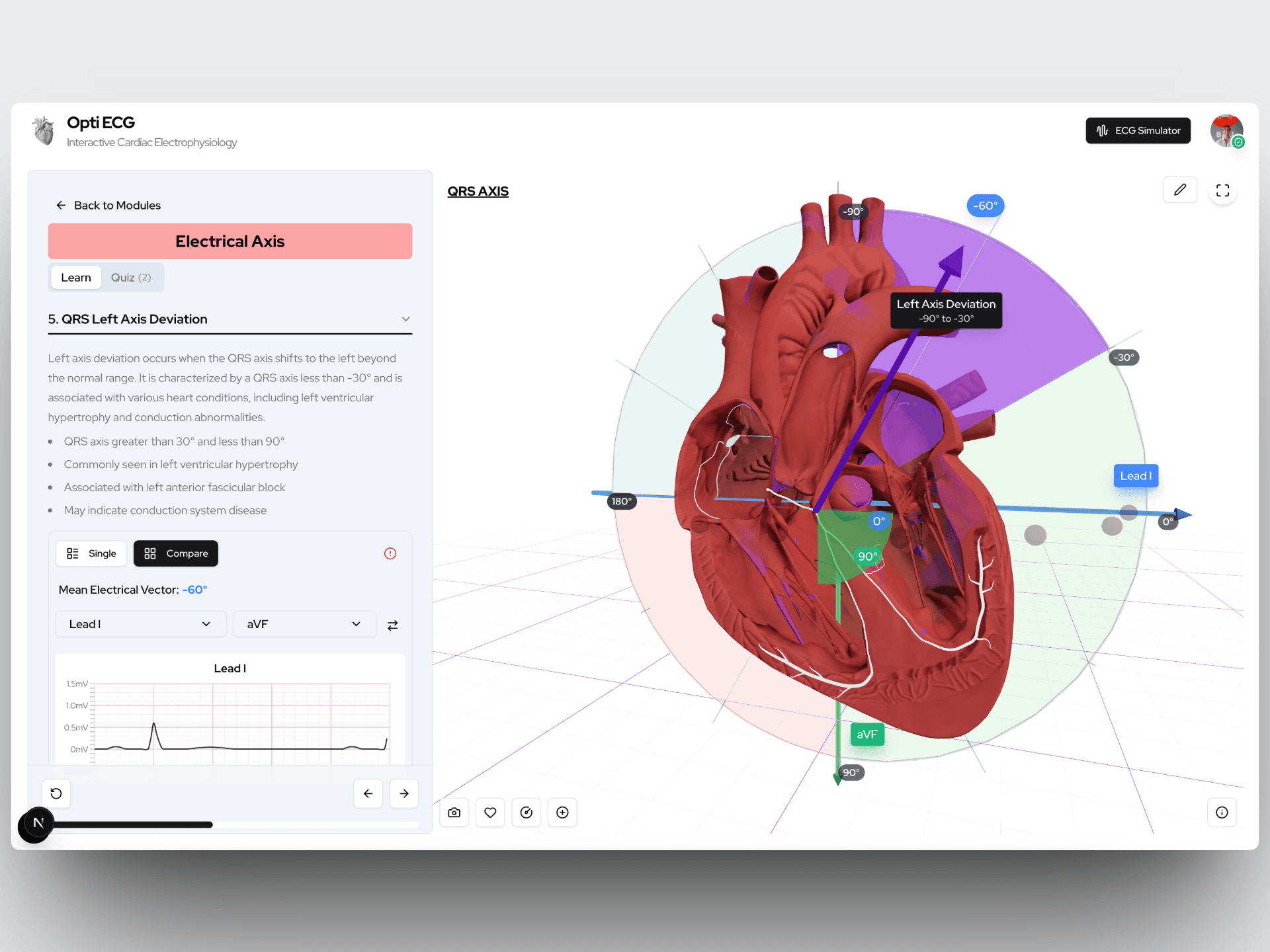
See Supraventricular Tachycardia in 3D
Explore ECG rhythms interactively with our simulator and 3D heart visualization synced beat-for-beat. See how electrical activity produces every wave on the tracing.
Related Topics
How helpful was this page?