Also known as: RBBB
ECG Characteristics
| Heart Rate | Normal (depends on underlying rhythm) |
| Rhythm | Regular (depends on underlying rhythm) |
| P Wave | Normal |
| PR Interval | Normal (unless concurrent first-degree block) |
| QRS Duration | ≥ 0.12 seconds (complete RBBB); 0.10–0.12 seconds (incomplete) |
Mechanism
The right bundle branch is blocked, so the right ventricle depolarizes late via myocyte-to-myocyte spread from the left ventricle rather than through the normal conduction system.
Key Features on ECG
- RSR' ('M-shaped') pattern in V1–V2
- Wide, slurred S wave in leads I and V6
- QRS duration ≥ 0.12 seconds
- Normal or rightward axis
- ST-T changes discordant to terminal QRS deflection
Causes
- Right ventricular strain (PE, pulmonary hypertension)
- Right heart disease (ASD, RV dilation)
- Conduction system fibrosis
- Normal variant in young adults
- Post-cardiac surgery
- Myocarditis
Clinical Significance
Isolated RBBB can be a normal variant, especially in young individuals. New RBBB in the setting of acute illness may indicate right heart strain (pulmonary embolism, acute cor pulmonale). RBBB does not interfere with standard MI diagnosis on ECG.
Frequently Asked Questions
What does RSR' mean in RBBB?
RSR' describes the characteristic QRS morphology in lead V1: an initial small R wave (septal depolarization left-to-right), an S wave (left ventricular depolarization away from V1), and a second R' wave (delayed right ventricular depolarization toward V1). This creates an M-shaped complex, sometimes described as 'rabbit ears.'
Can you diagnose MI in the presence of RBBB?
Yes, unlike LBBB, RBBB does not significantly interfere with MI diagnosis. The initial depolarization (first 0.04 seconds) is normal in RBBB because the left bundle branch conducts normally. Therefore, pathological Q waves, ST elevation, and T wave inversions can be interpreted normally.
Is RBBB common in dogs?
RBBB can occur in dogs but is less common than in humans. It may be associated with right ventricular enlargement, heartworm disease, or conduction system fibrosis. In dogs, the QRS duration threshold for complete RBBB is shorter given their smaller heart size.
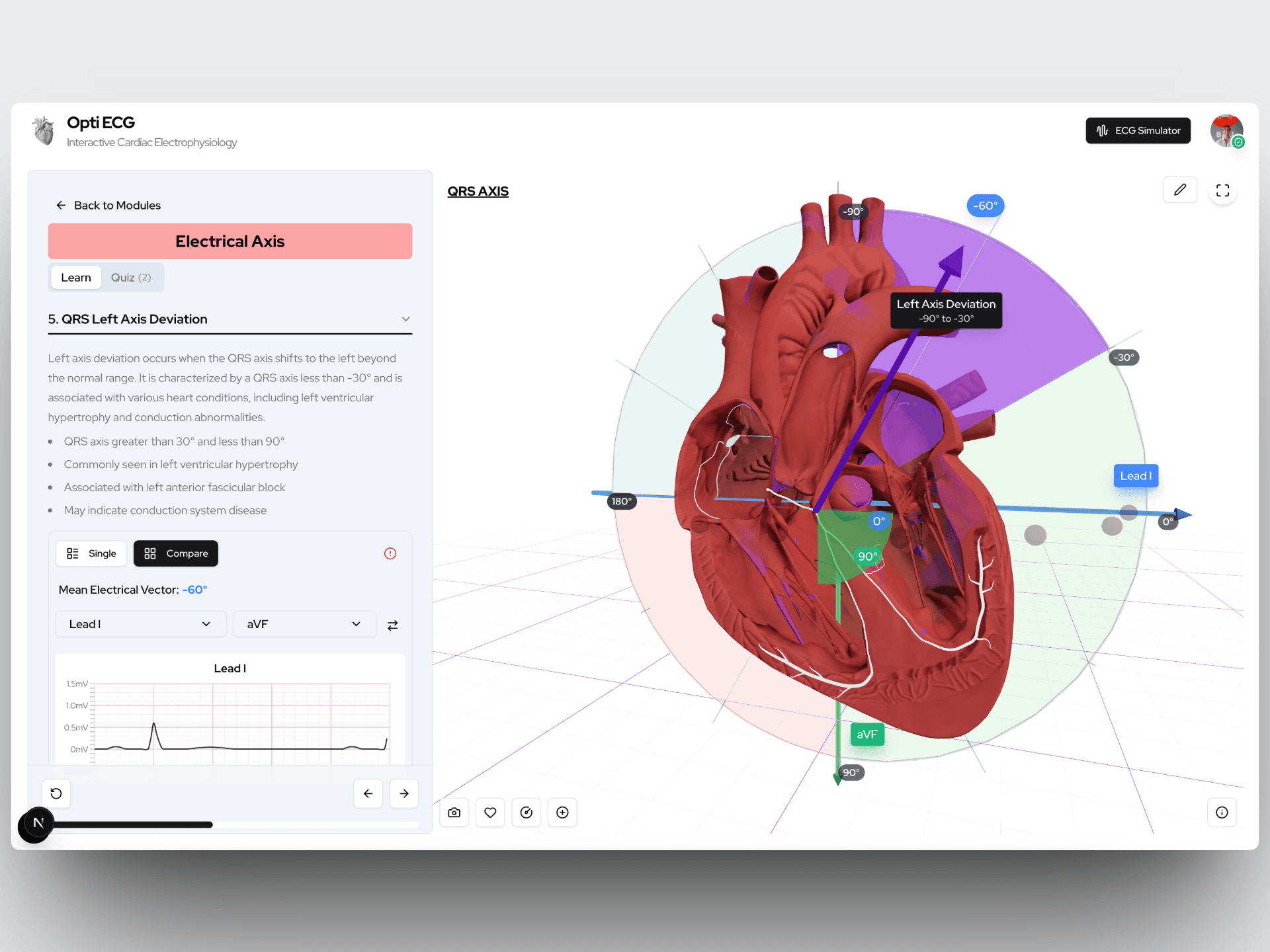
See Right Bundle Branch Block in 3D
Watch Right Bundle Branch Block unfold on a beating 3D heart synced to the ECG. Scrub the timeline, highlight each lead, and see exactly how the rhythm produces the tracing.
Related Topics
How helpful was this page?