Also known as: V1, Chest Lead 1, Precordial Lead 1
Lead Properties
| Lead Type | Precordial |
| Placement | Positive electrode at the right sternal border, fourth intercostal space (4th ICS, right of the sternum). In veterinary practice, electrode placement must be adjusted for species-specific thoracic anatomy. |
| View of Heart | Right ventricle, interventricular septum, and posterior left ventricular wall (via posterior forces). V1 is closest to the right side of the heart and septum, making it the primary lead for detecting right bundle branch block, right ventricular hypertrophy, posterior MI, and WPW accessory pathway localization. |
| Clinical Use | Diagnosing right bundle branch block (rsR' or rSR' pattern), left bundle branch block (broad negative QS), right ventricular hypertrophy, posterior MI (tall R wave with ST depression), atrial flutter sawtooth identification, and P wave morphology for atrial rhythm analysis. |
Normal Findings
- Small r wave (initial septal depolarization leftward) followed by deep S wave
- rS or QS complex — predominantly negative overall
- Upright P wave (may be biphasic: positive then negative component)
- T wave normally inverted in V1 (negative T in V1 is a normal finding)
- R wave amplitude normally small (< 5 mm); r wave/S wave ratio < 1
- QRS duration < 0.12 s
Abnormal Findings
- RSR' pattern (rabbit ears) indicating right bundle branch block (QRS ≥ 0.12 s)
- Broad, deep QS or rS pattern with wide S indicating left bundle branch block
- Tall R wave (R > S) suggesting posterior MI, right ventricular hypertrophy, or WPW
- ST elevation (Brugada pattern: coved or saddleback) in Brugada syndrome
- ST depression with tall R waves suggesting posterior STEMI
- Sawtooth baseline at 300 bpm suggesting atrial flutter
- Delta wave on upstroke of QRS in Wolff-Parkinson-White syndrome
Frequently Asked Questions
Why does V1 show a predominantly negative QRS complex in normal individuals?
V1 is placed at the right sternal border, facing the right ventricle and septum. The dominant electrical event in ventricular depolarization is left ventricular activation, which produces a large vector directed leftward, posteriorly, and inferiorly — away from V1's positive electrode. The only positive deflection (the small r wave) represents the initial septal depolarization moving toward V1. Once the dominant left ventricular forces activate, the vector moves away, producing the deep S wave that dominates V1's morphology.
What is the RSR' pattern in V1 and what does it mean?
The RSR' pattern (also called 'rabbit ears' or 'M-shaped' QRS) in V1 consists of an initial r wave, a downward S wave, and a second upward R' wave. When the QRS is ≥ 0.12 s, this pattern in V1 paired with broad S waves in the lateral leads (I, aVL, V5, V6) is the defining feature of right bundle branch block (RBBB). In RBBB, the right ventricle depolarizes late via slow myocardial conduction rather than the rapid Purkinje system, producing delayed rightward terminal forces that register as the R' wave in V1.
How is V1 used to identify posterior myocardial infarction?
The posterior left ventricular wall lacks a direct anterior-facing precordial lead, so posterior MI is identified as a mirror image (reciprocal) finding in V1 and V2. In posterior STEMI, the infarcted posterior wall loses its electrical contribution, and the anterior wall forces are unopposed, producing tall, broad R waves (R > S) and ST depression in V1–V2. If the ECG is turned upside down and viewed from behind, the ST depression becomes elevation and the tall R becomes a Q wave — the classic 'posterior MI mirror' technique. Confirming V7–V9 posterior leads showing ST elevation solidifies the diagnosis.
What is the Brugada pattern and how is it identified in V1?
Brugada syndrome is a channelopathy caused by mutations in cardiac sodium or calcium channel genes that predisposes to life-threatening ventricular arrhythmias. Its ECG hallmark is a characteristic ST elevation in V1–V3 in two distinct patterns: the Type 1 (diagnostic) coved pattern shows ≥ 2 mm downsloping ST elevation leading directly into an inverted T wave (resembling a shark fin or right bundle branch block); the Type 2 saddleback pattern shows ST elevation with a saddleback morphology and an upright or biphasic T wave. Only Type 1 is diagnostic of Brugada syndrome; Type 2 may convert to Type 1 after sodium channel blocker challenge.
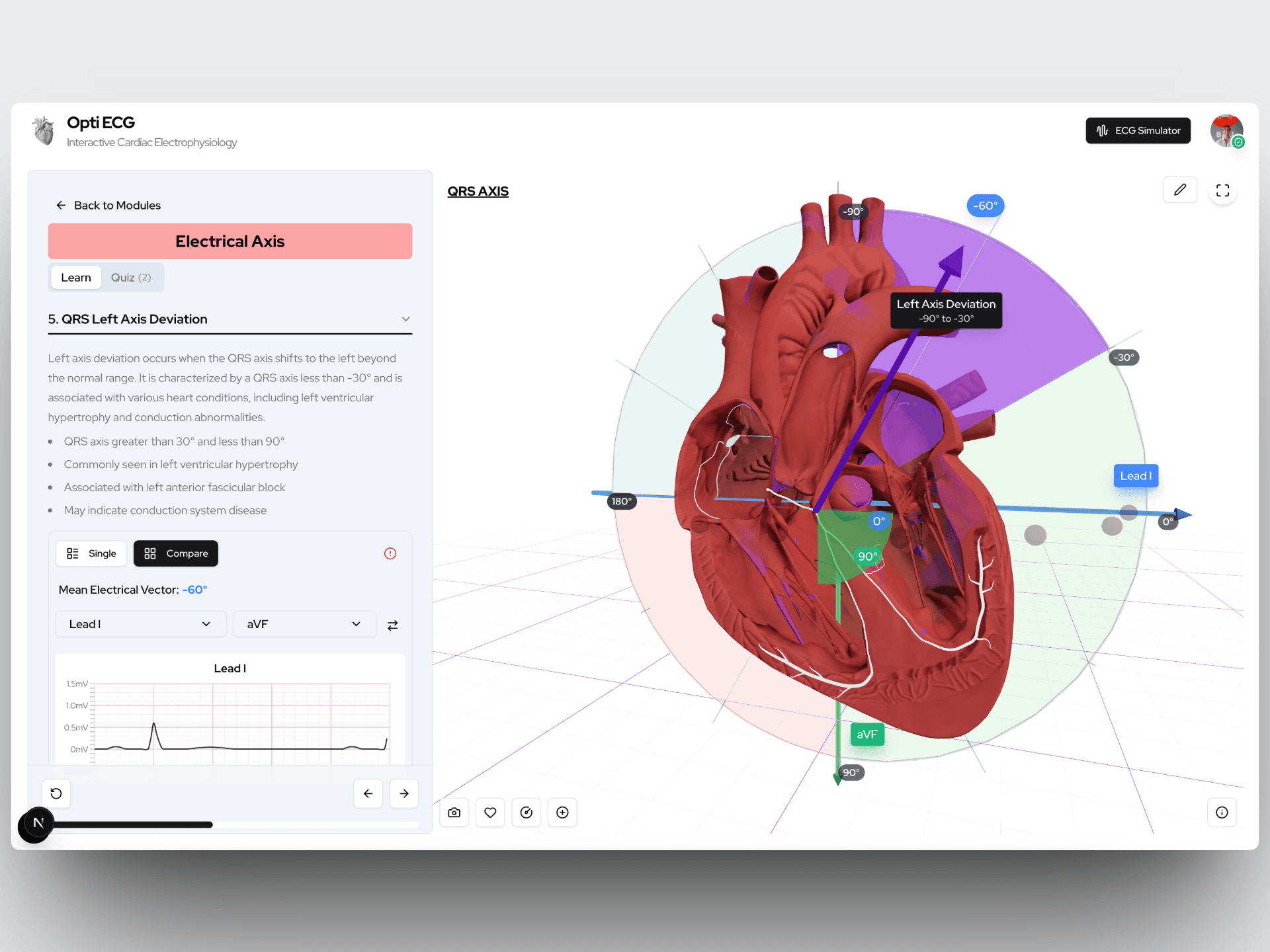
See Precordial Lead V1 in 3D
Explore ECG rhythms interactively with our simulator and 3D heart visualization synced beat-for-beat. See how electrical activity produces every wave on the tracing.
Related Topics
How helpful was this page?