Also known as: V2, Chest Lead 2, Precordial Lead 2
Lead Properties
| Lead Type | Precordial |
| Placement | Positive electrode at the left sternal border, fourth intercostal space (4th ICS, left of the sternum). V2 is directly adjacent to V1 and shares the same intercostal level. |
| View of Heart | Interventricular septum and right ventricular free wall, with contributions from the anterior wall of the left ventricle. V2 shows transition morphology and is particularly sensitive to septal and anterior left ventricular activity. |
| Clinical Use | Assessing anterior and septal MI, evaluating R-wave progression, detecting bundle branch blocks, diagnosing Brugada pattern, identifying posterior MI (reciprocal tall R and ST depression), and assessing left ventricular hypertrophy voltage criteria. |
Normal Findings
- Predominantly negative QRS — rS complex common (larger r wave than V1 but still S-dominant)
- R wave slightly larger than in V1 (beginning of normal R-wave progression)
- Upright or biphasic P wave
- T wave may be upright or inverted — inverted T in V2 can be normal (particularly in women), but in most adults is abnormal
- QRS duration < 0.12 s
- r wave amplitude beginning to increase from V1 toward V6
Abnormal Findings
- Absent r wave (QS pattern) indicating anterior or anteroseptal infarction
- ST elevation in anterior STEMI (LAD territory)
- ST depression with tall R waves indicating posterior MI
- RSR' (RBBB pattern) — broader S in V2 relative to V1 in complete RBBB
- Brugada Type 1 or Type 2 pattern (may be more prominent in V1–V2)
- Deep S wave in LVH with voltage criteria (Sokolow-Lyon: S in V1 or V2 + R in V5 or V6 ≥ 35 mm)
- QS or rS with poor R-wave progression suggesting anterior MI or cardiomyopathy
Frequently Asked Questions
What is poor R-wave progression and what does it mean?
Poor R-wave progression (PRWP) refers to the failure of the R wave to increase normally from V1 through V4, with the R wave remaining small (< 3 mm) or declining in amplitude through the precordial leads. Normally, the R wave grows progressively from V1 to V5 before plateauing or declining at V6. PRWP can indicate anterior myocardial infarction (particularly anteroseptal MI from LAD occlusion), left ventricular hypertrophy, left bundle branch block, right ventricular hypertrophy, or it may be a normal variant — particularly in elderly patients or those with obesity or COPD.
How is V2 used in diagnosing anterior myocardial infarction?
Lead V2 — along with V1, V3, and V4 — is one of the anterior group leads and is essential for diagnosing LAD occlusion. ST elevation ≥ 2 mm in V2 (the threshold is higher than in other leads due to normal T-wave amplitude) indicates anterior STEMI when accompanied by similar changes in adjacent leads. Loss of the r wave (QS complex) in V2 in the setting of acute chest pain indicates transmural infarction with septal involvement. ST depression in V2 with a tall R wave is the mirror image of posterior STEMI.
Why is T-wave inversion in V2 considered more significant than in V1?
While T-wave inversion in V1 is a normal finding in many adults, T-wave inversion in V2 (especially in adults without prior ECG changes) is generally considered abnormal and warrants investigation. In the absence of bundle branch block or ventricular hypertrophy, new deep T-wave inversion in V2 can represent Wellens syndrome — a pattern of critical LAD stenosis in which the patient is between anginal episodes but is at high risk for imminent anterior STEMI. Wellens Type A shows biphasic T waves; Wellens Type B shows deep symmetric T-wave inversions in V2–V3.
What is Wellens syndrome and why is it important to recognize in V2?
Wellens syndrome is a pre-infarction pattern caused by critical stenosis of the proximal left anterior descending artery. The characteristic ECG findings — biphasic T waves (Type A) or deep, symmetric T-wave inversions (Type B) in V2 and V3 — appear when the patient is pain-free or between anginal episodes, making them easy to overlook. These patients are at high risk for massive anterior STEMI and require urgent cardiology evaluation and coronary angiography. Exercise stress testing is contraindicated in suspected Wellens syndrome because it can precipitate LAD occlusion during the stress.
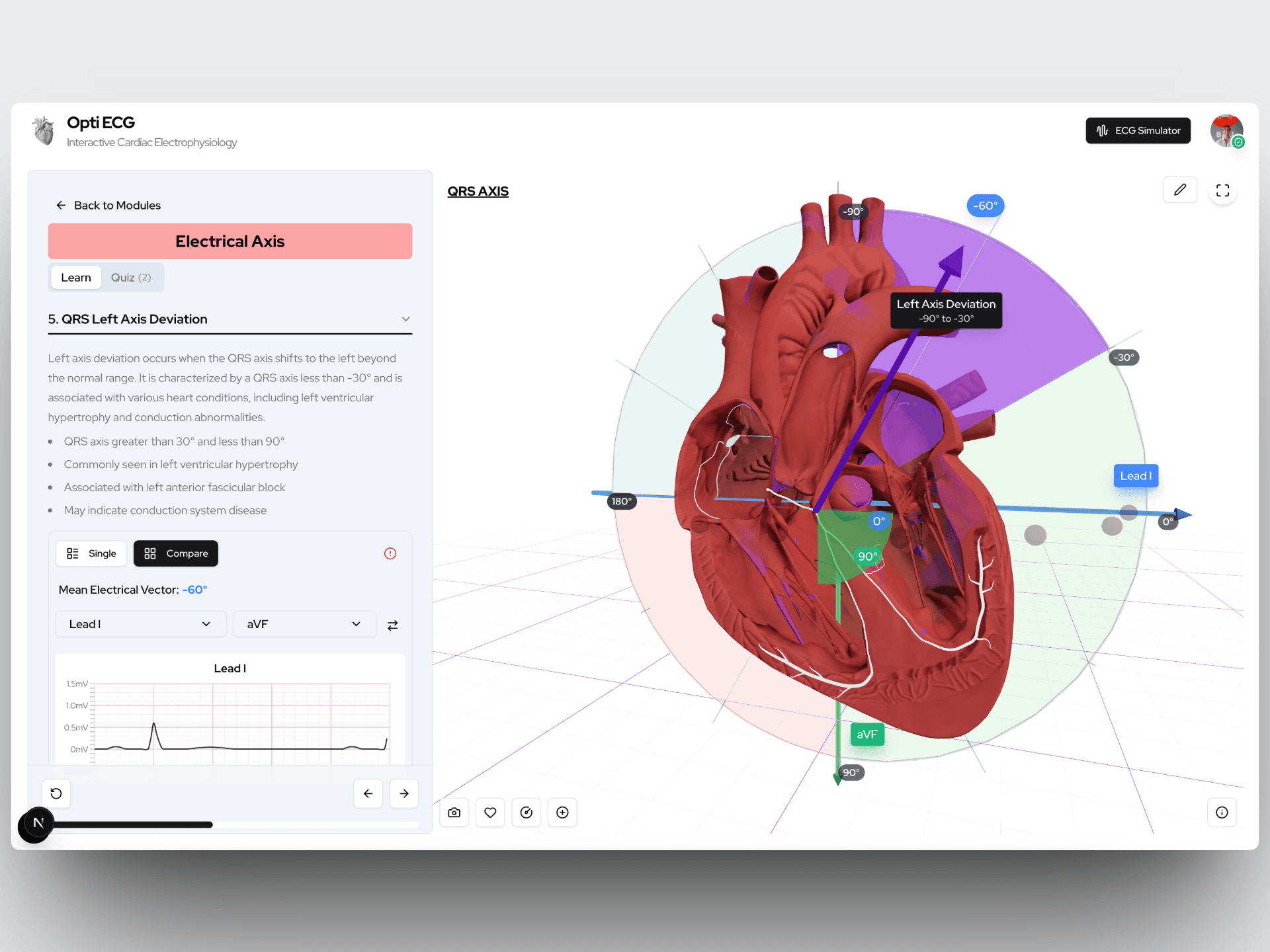
See Precordial Lead V2 in 3D
Explore ECG rhythms interactively with our simulator and 3D heart visualization synced beat-for-beat. See how electrical activity produces every wave on the tracing.
Related Topics
How helpful was this page?