Also known as: V3, Chest Lead 3, Precordial Lead 3
Lead Properties
| Lead Type | Precordial |
| Placement | Positive electrode placed between V2 and V4 — midway between the left sternal border (V2) and the midclavicular line at the fifth intercostal space (V4). Exact placement is equidistant between these two reference points. |
| View of Heart | Anterior wall of the left ventricle and lower interventricular septum. V3 is a transitional lead where the QRS complex changes from predominantly negative (as in V1–V2) to predominantly positive (as in V4–V6), representing the transition from right-facing to left-facing views. |
| Clinical Use | Evaluating anterior MI, assessing R-wave progression (V3 is a key landmark for the transition zone), diagnosing anteroseptal STEMI, and contributing to LVH voltage criteria (Cornell criterion uses S in V3). |
Normal Findings
- Transitional QRS — may be isoelectric (R approximately equals S), predominantly positive, or predominantly negative depending on individual anatomy
- R wave typically larger than in V2, approaching or exceeding S wave amplitude
- Upright T wave in most adults (T-wave inversion in V3 warrants investigation)
- Upright P wave
- QRS duration < 0.12 s
- Normal transition zone typically at V3 or V4
Abnormal Findings
- ST elevation indicating anteroseptal or anterior STEMI
- QS or absent r wave in anteroseptal MI
- Deep symmetric T-wave inversion (Wellens Type B pattern extending from V2 to V3)
- Biphasic T waves (Wellens Type A) in critical proximal LAD stenosis
- Persistent S-dominant pattern through V3 and V4 indicating poor R-wave progression
- Early transition (RS ratio > 1 in V1 or V2) suggesting posterior MI, WPW, or RBBB pattern
Frequently Asked Questions
What is the transition zone and why does it matter in V3?
The transition zone is the precordial lead position where the QRS complex changes from predominantly negative (S > R) to predominantly positive (R > S). In most healthy individuals, this transition occurs at V3 or V4. An early transition (at V1 or V2) may suggest posterior MI, right ventricular hypertrophy, or Wolff-Parkinson-White syndrome with a posterior accessory pathway. A late transition (at V5 or V6, or no transition at all) suggests poor R-wave progression, which may indicate anterior MI, left ventricular hypertrophy, or normal variant in some individuals.
How is V3 used in the Cornell voltage criteria for LVH?
The Cornell voltage criteria for left ventricular hypertrophy combines the R wave in aVL with the S wave in V3. An R in aVL + S in V3 > 28 mm in men or > 20 mm in women meets voltage criteria for LVH. The Cornell criteria have better sensitivity than the Sokolow-Lyon criteria in patients with obesity or pulmonary disease, where chest wall thickness attenuates precordial voltage. Voltage criteria alone are neither sensitive nor specific enough to independently diagnose LVH; they are most valuable when combined with other findings such as ST-T changes, left atrial enlargement, and clinical context.
What ST changes in V3 require immediate attention?
ST elevation ≥ 2 mm in V3 in a patient with chest pain is a STEMI criterion requiring immediate activation of the cardiac catheterization lab. V3 elevation that is part of a pattern extending from V1 through V4 or beyond indicates proximal LAD occlusion with large territory at risk. Conversely, deep T-wave inversion or biphasic T waves in V3 in a pain-free patient with a recent history of chest pain should raise concern for Wellens syndrome — a pattern of critical LAD stenosis that is easily missed and associated with high risk of imminent MI.
Can normal individuals have an isoelectric QRS in V3?
Yes — an isoelectric QRS in V3 (where R and S waves are roughly equal in amplitude) is frequently a normal finding, as V3 often lies precisely at the cardiac electrical transition zone. The transition zone position varies with body habitus, cardiac rotation, and chest geometry. A patient with a horizontally oriented heart may transition early (at V2–V3), while a patient with a more vertical or clockwise rotation may not reach equal R and S amplitudes until V4 or V5. The transition zone finding must be interpreted in context of the full 12-lead ECG rather than as an isolated abnormality.
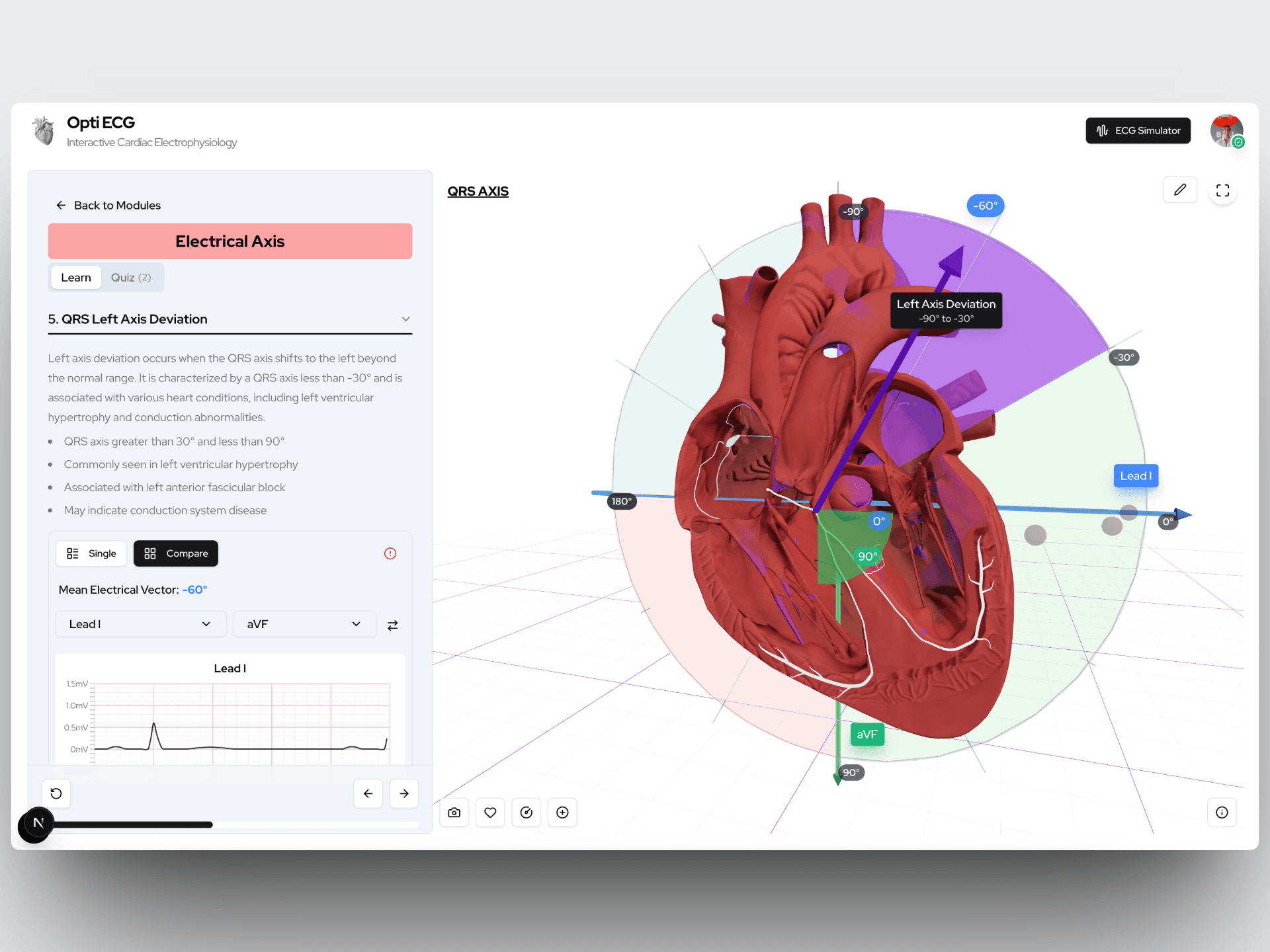
See Precordial Lead V3 in 3D
Explore ECG rhythms interactively with our simulator and 3D heart visualization synced beat-for-beat. See how electrical activity produces every wave on the tracing.
Related Topics
How helpful was this page?