Also known as: Atrial Depolarization Wave, Atrial Wave
Measurement
| Normal Range | Normal P wave duration is less than 0.12 seconds (120 ms). Normal P wave amplitude is less than 2.5 mm in limb leads and less than 1.5 mm in V1. The P wave is normally upright (positive) in leads I, II, aVF, and V4-V6, and inverted (negative) in aVR. A normal P wave axis is 0 to +75 degrees. |
| Measurement | Measure P wave duration from the beginning to the end of the P wave deflection. Amplitude is measured from the isoelectric PR baseline to the peak of the P wave. Assess P wave morphology in leads II (best for upright P wave) and V1 (best for demonstrating notching and biphasic components reflecting right vs. left atrial contributions). Also assess for consistent P wave morphology — varying P wave shapes suggest multiple atrial foci. |
Clinical Significance
The P wave is the primary ECG indicator of atrial activity and SA node function. Its presence, regularity, morphology, and relationship to the QRS complex are the basis for rhythm classification. Absent P waves suggest atrial fibrillation or flutter. P wave morphology abnormalities indicate atrial enlargement (right or left atrial abnormality). Abnormal P wave axis or morphology suggests an ectopic atrial pacemaker rather than SA nodal origin. Retrograde P waves (inverted in II, upright in aVR) indicate junctional or ventricular impulse conduction back through the atria.
Abnormalities
Right Atrial Enlargement (P Pulmonale)
Tall, peaked P waves greater than 2.5 mm in lead II (and often III, aVF) with normal or short P wave duration. The term 'P pulmonale' reflects its association with pulmonary hypertension, cor pulmonale, right-sided heart failure, congenital right heart lesions, and tricuspid valve disease. The tall P wave reflects increased right atrial depolarization force.
Left Atrial Enlargement (P Mitrale)
Broad, notched P waves in limb leads (duration ≥0.12 seconds, often with a double peak separated by more than 40 ms) and a deep, broad negative terminal component in V1 (greater than 1 mm wide and 1 mm deep). The term 'P mitrale' reflects its classic association with mitral stenosis, though left atrial enlargement from any cause (hypertension, mitral regurgitation, cardiomyopathy) produces the same pattern.
Atrial Fibrillation (Absent P Waves)
Replacement of normal P waves by chaotic, fibrillatory baseline activity (f waves) with an irregularly irregular ventricular response. The absence of organized atrial depolarization is the hallmark of AFib. The fibrillatory baseline is best seen in V1 and inferior leads. The ventricular rate depends on AV nodal conduction and can range from very slow to very rapid.
Ectopic Atrial Rhythm
P waves with abnormal morphology or axis indicating impulse origin from a site other than the SA node. Low atrial rhythms produce inverted P waves in inferior leads (II, III, aVF) because depolarization propagates superiorly rather than inferiorly. Wandering atrial pacemaker shows at least three distinct P wave morphologies as the pacemaker site shifts among different atrial foci.
Retrograde P Waves
Inverted P waves in leads II, III, aVF and upright in aVR, indicating atrial activation in a retrograde (inferior-to-superior) direction. This pattern is seen with junctional rhythms, junctional tachycardias, and ventricular rhythms where conduction travels backward through the AV node into the atria. Retrograde P waves may appear before, within, or after the QRS depending on the relative speeds of anterograde ventricular and retrograde atrial conduction.
Frequently Asked Questions
How do I identify the P wave in a tachyarrhythmia?
P waves can be hidden within or distorted by preceding T waves during tachyarrhythmias, making identification challenging. Useful strategies include examining V1, which often shows the smallest QRS complex and T wave, making buried P waves more visible; looking for subtle deformities on the downslope of T waves; using the Lewis lead (right arm positive, left leg negative) to amplify atrial activity; and performing vagal maneuvers or adenosine administration to transiently slow the ventricular rate, which can unmask underlying atrial activity or flutter waves.
What does a biphasic P wave in V1 mean?
A biphasic P wave in V1 (with an initial positive component followed by a negative terminal deflection) reflects the sequential depolarization of the right and left atria. The initial positive component represents right atrial activation (depolarizing toward the V1 electrode), while the terminal negative component represents left atrial activation (depolarizing away from V1). A terminal negative component in V1 that is wider than 40 ms and deeper than 1 mm meets criteria for left atrial abnormality, suggesting left atrial enlargement or interatrial conduction delay.
What is sinoatrial block and how does it affect the P wave?
Sinoatrial (SA) block occurs when the SA node fires but fails to conduct the impulse to the surrounding atrial tissue, resulting in a missing P wave and corresponding QRS complex. In SA block, the pause is typically a multiple of the normal PP interval (because the SA node continues firing at its regular rate internally but the beat is not conducted). This distinguishes SA block from sinus pause/arrest, where the SA node itself fails to fire and the pause is not a multiple of the baseline PP interval.
How does the P wave differ in junctional rhythms?
In junctional rhythms, the impulse originates in or near the AV node and conducts both antegrade to the ventricles (producing a normal narrow QRS) and retrograde into the atria (producing inverted P waves in leads II, III, aVF). The position of the retrograde P wave relative to the QRS depends on the relative conduction velocities: if retrograde conduction to the atria is faster than anterograde conduction to the ventricles, the inverted P wave precedes the QRS with a short PR interval less than 0.12 seconds; if conduction is simultaneous, P waves are buried within the QRS; and if ventricular conduction is faster, inverted P waves follow the QRS in the ST segment.
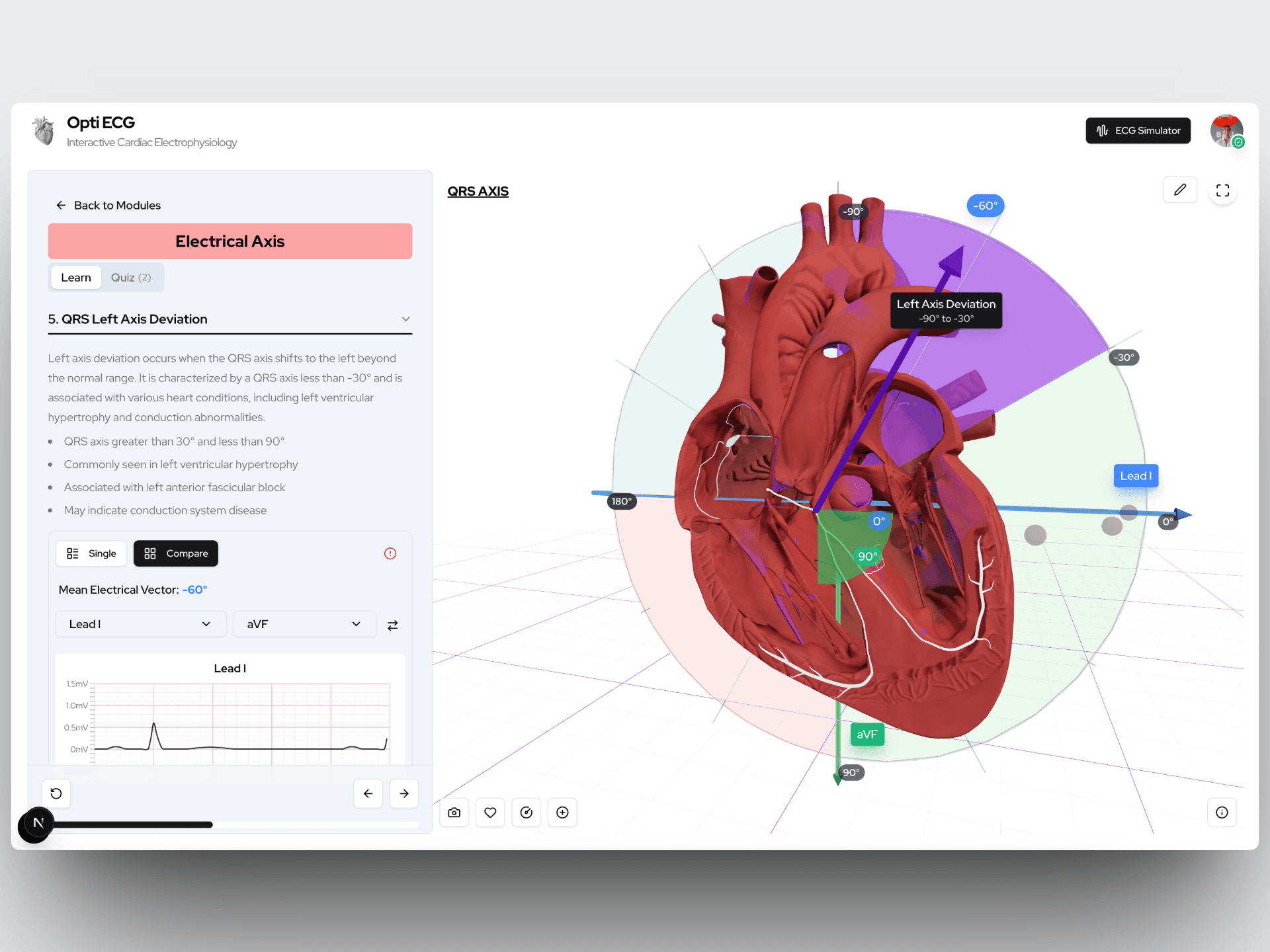
See P Wave in 3D
Explore ECG rhythms interactively with our simulator and 3D heart visualization synced beat-for-beat. See how electrical activity produces every wave on the tracing.
Related Topics
How helpful was this page?