Also known as: LAF, Left Anterior Hemiblock, Left Anterior-Superior Fascicle, Anterior Division of Left Bundle Branch
Anatomy & Physiology
| Location | The left anterior fascicle arises from the superior-anterior portion of the left bundle branch and courses anteriorly and superiorly toward the anterior papillary muscle and the anterolateral free wall of the left ventricle. It runs along the left ventricular outflow tract beneath the endocardium. |
| Function | The left anterior fascicle activates the anterior and lateral walls of the left ventricle. Working together with the left posterior fascicle, it ensures that the left ventricle depolarizes in a coordinated pattern from endocardium to epicardium. The two fascicles produce opposite initial and terminal QRS vectors that normally balance each other. |
| Conduction Velocity | 2.0–4.0 m/s |
| Blood Supply | Primarily supplied by the first septal perforator and diagonal branches of the left anterior descending artery (LAD). It has a single blood supply, which is why it is more vulnerable to ischemic block than the left posterior fascicle. |
Clinical Relevance
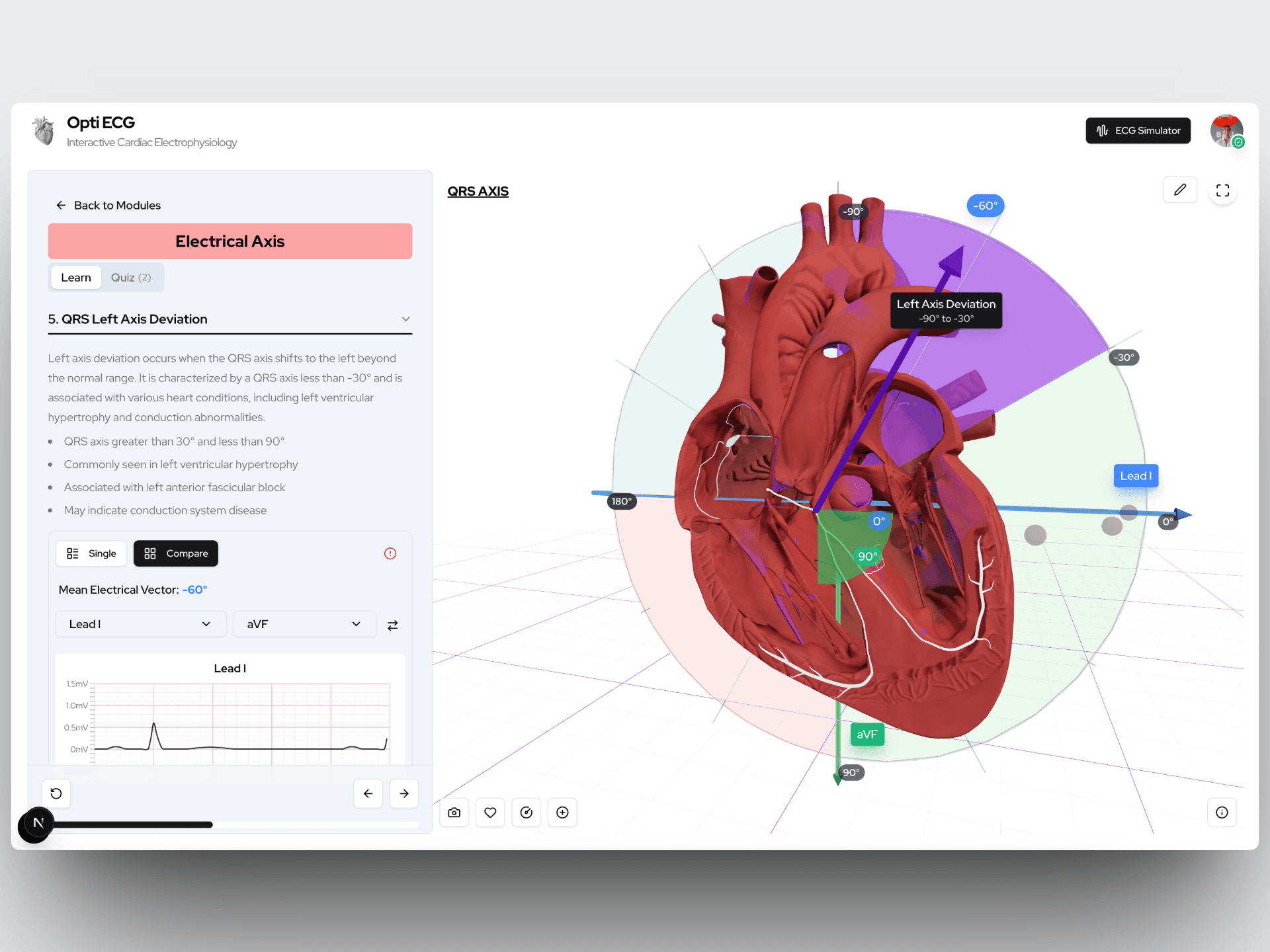
LAFB is the most common fascicular block, characterized by marked left axis deviation (–45° to –90°), small Q waves in leads I and aVL, and small R waves in leads II, III, and aVF. The QRS is only mildly prolonged (< 120 ms) or normal in isolated LAFB. When combined with RBBB, it forms the most common form of bifascicular block (RBBB + LAFB), which carries a risk of progression to complete heart block if the remaining left posterior fascicle is also diseased.
Associated Pathologies
- Left anterior fascicular block (LAFB)
- Left anterior hemiblock
- Bifascicular block (RBBB + LAFB)
- Trifascicular block
- Anterior MI (LAD territory)
- Hypertensive heart disease
Frequently Asked Questions
How do you diagnose left anterior fascicular block on ECG?
Left anterior fascicular block (LAFB) is diagnosed when the following criteria are met: (1) left axis deviation between –45° and –90°; (2) small Q waves in leads I and aVL (qR pattern); (3) small R waves in leads II, III, and aVF (rS pattern); (4) QRS duration < 120 ms (not a full bundle branch block); and (5) no other cause of left axis deviation such as inferior MI or Wolff-Parkinson-White. The left axis deviation in LAFB results from the posterior fascicle activating the inferior wall first, shifting the mean QRS vector superiorly.
Why is the left anterior fascicle more commonly blocked than the left posterior fascicle?
The left anterior fascicle is thinner, longer, and has a single blood supply (from the LAD), making it more anatomically vulnerable to both ischemia and mechanical damage. The left posterior fascicle is shorter, broader, and has a dual blood supply from both the LAD and the posterior descending artery, giving it redundant perfusion and greater resistance to block.
Does isolated LAFB require treatment?
Isolated LAFB does not require specific treatment and does not itself require pacing. However, it is important to determine the underlying cause and to monitor for progression to bifascicular or trifascicular block, particularly in patients with known coronary disease. When LAFB is combined with RBBB (bifascicular block), electrophysiology study or pacemaker implantation may be considered if symptoms of pre-syncope or syncope are present.
What is the difference between LAFB and inferior MI as a cause of left axis deviation?
Both LAFB and inferior MI can cause left axis deviation. The key distinction is in lead morphology. In inferior MI, leads II, III, and aVF show pathological Q waves (wide, > 40 ms, or > 25% of R wave height) from prior necrosis. In LAFB, these leads show small R waves (rS pattern) without pathological Q waves. Clinical context and troponin history also help distinguish them.
What is trifascicular block?
Trifascicular block refers to conduction disease in all three fascicles: the right bundle branch, the left anterior fascicle, and the left posterior fascicle. Strictly defined, it implies complete block in one fascicle plus partial block (prolonged conduction) in the remaining two. The ECG typically shows RBBB plus LAFB plus first-degree AV block. True trifascicular block is a precursor to complete heart block and usually warrants prophylactic pacemaker implantation.
See Left Anterior Fascicle in 3D
Explore ECG rhythms interactively with our simulator and 3D heart visualization synced beat-for-beat. See how electrical activity produces every wave on the tracing.
Related Topics
How helpful was this page?