Also known as: LPF, Left Posterior Hemiblock, Left Posterior-Inferior Fascicle, Posterior Division of Left Bundle Branch
Anatomy & Physiology
| Location | The left posterior fascicle arises from the inferior-posterior portion of the left bundle branch and courses posteriorly and inferiorly toward the posterior papillary muscle and the inferior-posterior free wall of the left ventricle. It is broader and shorter than the left anterior fascicle. |
| Function | The left posterior fascicle activates the posterior and inferior walls of the left ventricle. It works in concert with the left anterior fascicle to ensure coordinated left ventricular depolarization. The posterior fascicle creates the inferior initial forces that produce normal Q waves in leads II, III, and aVF. |
| Conduction Velocity | 2.0–4.0 m/s |
| Blood Supply | Dual blood supply from the posterior descending artery (PDA, derived from the RCA or LCx in right-dominant and left-dominant circulations respectively) and from the left anterior descending artery (LAD). This dual supply is why isolated LPFB is rare and implies severe multivessel disease when it occurs. |
Clinical Relevance
LPFB produces right axis deviation (> +90°) with a small R in leads I and aVL, and deep S waves in those leads, combined with small Q waves and tall R waves in leads II, III, and aVF. Before diagnosing LPFB, all other causes of right axis deviation must be excluded (RVH, lateral MI, normal variant in young adults, left pneumothorax). LPFB combined with RBBB is less common than RBBB + LAFB but carries similar risk of progression to complete heart block.
Associated Pathologies
- Left posterior fascicular block (LPFB)
- Left posterior hemiblock
- Bifascicular block (RBBB + LPFB)
- Trifascicular block
- Extensive coronary artery disease
- Inferior MI
Frequently Asked Questions
How do you diagnose left posterior fascicular block on ECG?
Left posterior fascicular block (LPFB) is diagnosed by: (1) right axis deviation > +90° (typically +90° to +180°); (2) small R waves in leads I and aVL with deep S waves (rS pattern); (3) small Q waves and tall R waves in leads II, III, and aVF (qR pattern); (4) QRS duration < 120 ms; and (5) exclusion of other causes of right axis deviation, particularly right ventricular hypertrophy, lateral MI, and normal variant. The right axis results from the anterior fascicle activating the superior wall first, shifting the mean vector inferiorly and rightward.
Why is left posterior fascicular block rare compared to LAFB?
The left posterior fascicle is anatomically protected by two features: it is broader (more redundant tissue) and it has a dual blood supply from both the LAD and the posterior descending artery. Blocking it requires either very extensive ischemia or multivessel disease. In contrast, the left anterior fascicle is narrow and has only a single blood supply from the LAD, making it far more susceptible to block.
What other conditions must be excluded before diagnosing LPFB?
Right axis deviation, the defining ECG feature of LPFB, has several common alternative causes that must be excluded: right ventricular hypertrophy (with associated P pulmonale and right precordial changes), lateral wall MI (which can shift the axis rightward), normal variant right axis in young slim individuals, COPD and pulmonary hypertension, and left pneumothorax. LPFB should only be diagnosed when these alternatives are eliminated.
Is LPFB clinically significant if found incidentally?
Yes. Unlike isolated RBBB, which can be a benign normal variant, isolated LPFB is almost always associated with underlying cardiac disease and should prompt investigation. Its rarity means that when it is found, extensive coronary artery disease, cardiomyopathy, or prior inferior MI is frequently the underlying cause. Electrophysiologic evaluation may be warranted, particularly if there is associated syncope or pre-syncope.
What is bifascicular block involving the left posterior fascicle?
RBBB combined with LPFB is a form of bifascicular block that produces RBBB morphology (RSR' in V1, wide S in V6) with right axis deviation (from LPFB). This is less common than RBBB + LAFB, but both carry risk of progression to complete heart block, particularly if there is also first-degree AV block (suggesting concurrent disease in the remaining pathway). These patients may require electrophysiologic evaluation and prophylactic pacing.
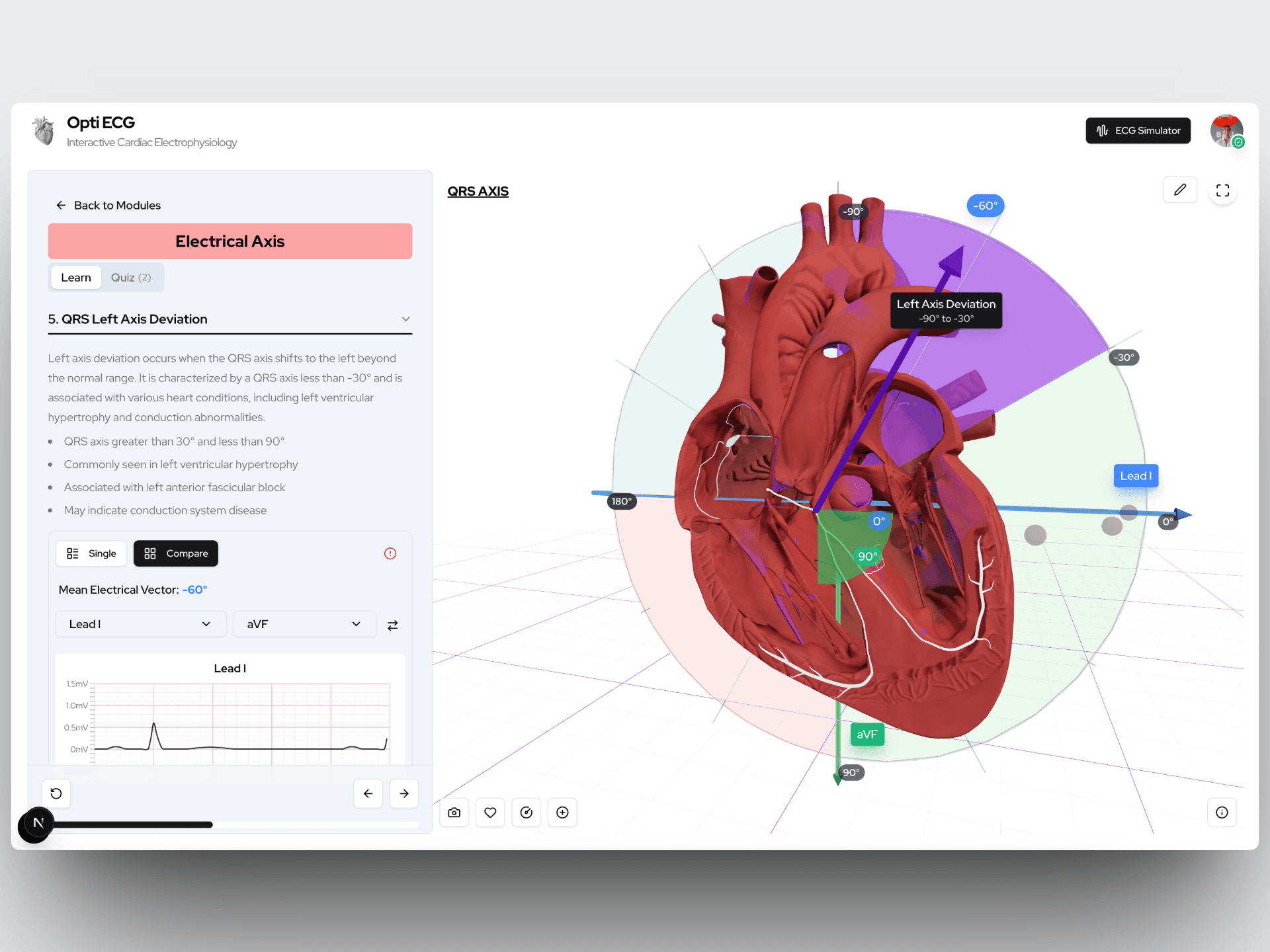
See Left Posterior Fascicle in 3D
Explore ECG rhythms interactively with our simulator and 3D heart visualization synced beat-for-beat. See how electrical activity produces every wave on the tracing.
Related Topics
How helpful was this page?